Celestial Atlas › Learn › Data sources, accuracy and credits
Data sources, accuracy and credits
Celestial Atlas computes positions with Astronomy Engine, checks them against NASA/JPL Horizons, draws real stars from ESA Gaia DR3 and the HYG catalogue, takes weather from Open-Meteo and uses published stellar-evolution and galaxy-dynamics papers for its simulations. Wherever the picture is a model or an artist's choice, the interface says so.
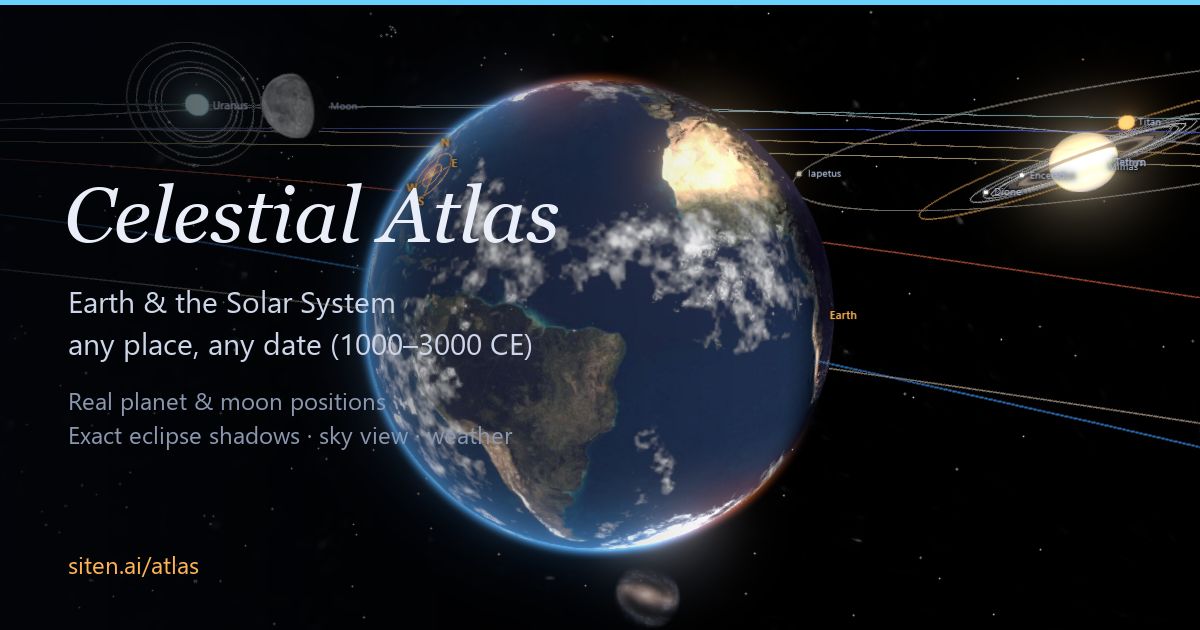
Positions of planets, Moon, Sun
Positions come from Astronomy Engine (Don Cross), which implements the standard VSOP87 theory for the planets, an analytic lunar theory for the Moon, and reproduces them to a fraction of an arcminute over centuries. The atlas compares itself with NASA/JPL Horizons topocentric positions for the Sun, Moon and planets across 1969–2026: worst-case errors are 1.2″ (Sun), 4.4″ (Moon) and 5″ (planets). Between 1700 and 2200 CE no warning is shown; outside it a banner warns of growing error (the Moon may be ≈ 15′ off by 2500 CE). Eclipse times depend also on ΔT, the difference between uniform and Earth-rotation time, which is extrapolated beyond the historical record.
The eclipse catalogue
All 9,641 solar and lunar eclipses between 1000 and 3000 CE were computed once with Astronomy Engine and stored as a compact table for instant timelines; the finder and the local-circumstances engine recompute any eclipse live. Spot checks against published events (2017 Aug 21, 2024 Apr 8, 2025 Sep 7, 2026 Aug 12, 2027 Aug 2) are part of the test suite.
Stars
The sky view uses 2,331 stars (HYG v4.0, from the Hipparcos catalogue) with proper motion, and constellation lines from d3-celestial. The Stars scale uses ESA Gaia DR3 data queried from the Gaia archive: 50,146 stars (1-in-12 sample, G < 10.5, parallax > 1 mas), 92,385 stars within 100 pc and 5,321 young hot stars at 100–650 pc; each is converted to galactic 3D coordinates from parallax. See Gaia stars near the Sun.
Galaxy dynamics and structure
The Sun's galactic orbit is integrated in a flat-rotation-curve potential from the Sun's present position (8.18 kpc, GRAVITY 2019), circular speed (233 km/s) and solar motion (U,V,W = 11.1, 12.24, 7.25 km/s; Schönrich et al. 2010). The Milky Way's structure parameters come from the review by Bland-Hawthorn & Gerhard (2016) and the spiral pattern speed from Dias et al. (2019). Local Group positions use McConnachie (2012); Laniakea uses Tully et al. (2014) and the Cosmicflows-3 catalogue.
Weather
Weather, geocoding and time-zone lookup use free Open-Meteo services. Your selected place's coordinates are sent to Open-Meteo to fetch the weather; nothing else leaves your browser, and the atlas has no analytics beyond the host's basic page statistics.
Textures and credits
Planet maps: Solar System Scope (CC BY 4.0, NASA-derived). Earth day/night/clouds/relief: NASA Visible Earth via the three.js examples. Milky Way artist's concept: NASA/JPL-Caltech. Hubble galaxy photographs: NASA/ESA via Wikimedia Commons. Satellite orbital elements: NASA/JPL SSD. Code: three.js (MIT), Astronomy Engine (MIT).
How it is tested
The repository contains a Node test-suite that checks the time and calendar code (round trips, DST, 1582, leap years), planet and moon distances, eclipses against known events, the galaxy orbit and spiral-arm geometry, the Local Group and Laniakea catalogue positions, the collision orbit's timeline, the Sun-life tables, the planet temperature model and translation coverage; and an end-to-end browser suite (Playwright with real Chrome) that drives the interface on desktop and phone sizes. A built-in self-test (menu ▸ About) runs the time-conversion checks inside your own browser.
A summary of what is illustrative
- Illustrative Enlarged bodies in explorable mode; compact moon systems at long range; the corona's shape; atmospheric glow.
- Illustrative Procedurally generated stars inside the Milky Way model, Local Group galaxies and Laniakea members.
- Illustrative The galaxy-collision simulation (restricted N-body), the star-formation proxy, the Sun-life temperature and ocean-loss models, the square-root distance scale in the Sun-life view.
- Real Everything else: positions, times, orbital elements, catalogue stars, weather values.
Frequently asked questions
How accurate are the planet positions in Celestial Atlas?
Within about 5 arcseconds of NASA/JPL Horizons between 1969 and 2026 (Sun 1.2″, Moon 4.4″), with graceful degradation outside 1700–2200 CE.
Where does the star data come from?
ESA's Gaia DR3 for the 3D star maps and the Hipparcos-derived HYG database for the sky view, with proper motions.
Is Celestial Atlas open source?
Yes, MIT-licensed on GitHub at github.com/sitens/celestial-atlas.
Which parts are simulated rather than measured?
The galaxy collision, the star-formation proxy, the Sun's life temperatures and ocean-loss model, and the generated stars inside galaxy models; each is labelled as illustrative in the interface and on these pages.