Celestial Atlas › Learn
Learn Celestial Atlas: the solar system and the universe, explained
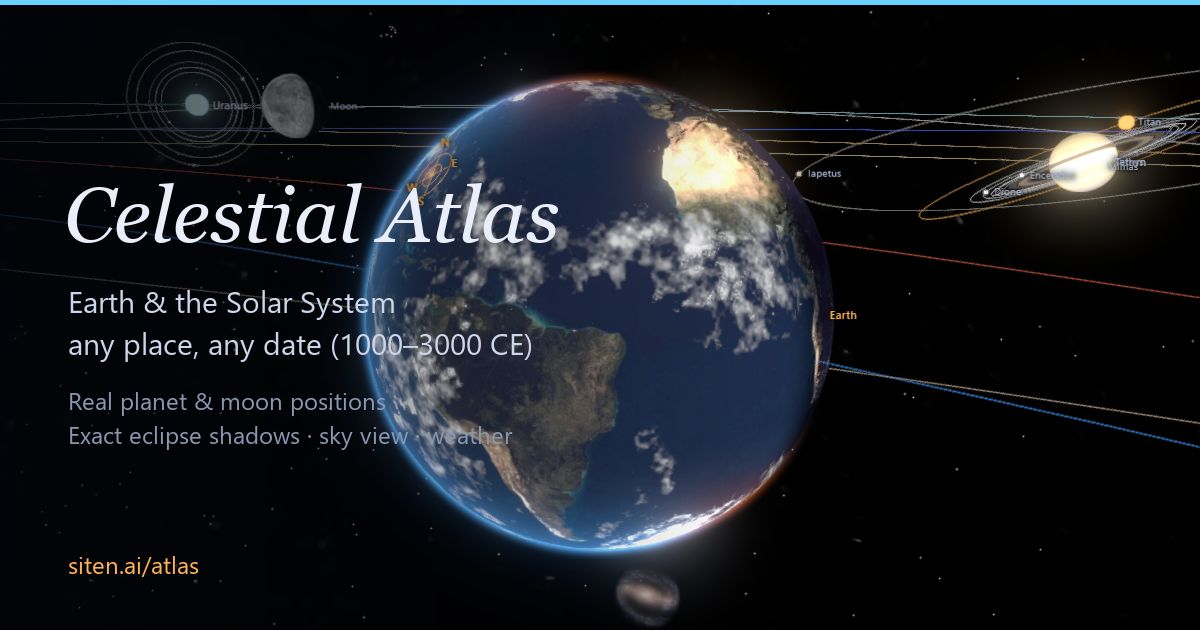
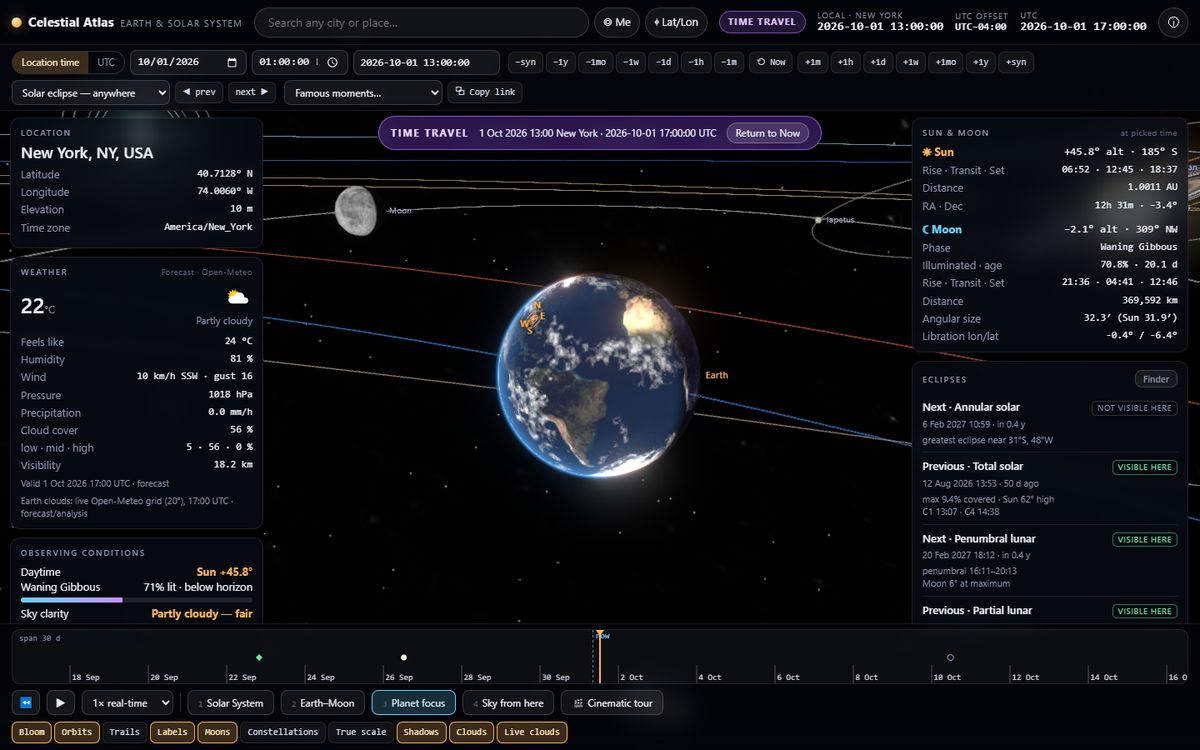
Celestial Atlas is a free, open-source 3D model of Earth, the solar system and the universe around it. It shows where the planets and Moon really are for any date from 1000 to 3000 CE, simulates solar and lunar eclipses, and zooms out through 100,000 stars, the Milky Way, Andromeda and the Laniakea supercluster. These pages explain what every part of it depicts, how it was calculated and what is real versus illustrative.
Start here
- New to it? Read how to use Celestial Atlas (controls, mobile gestures, sharing links, languages).
- Curious about space? Try how the Sun moves through the Galaxy or the Milky Way–Andromeda collision.
- Want the facts? See the FAQ, the glossary and data sources and accuracy.
The Solar System
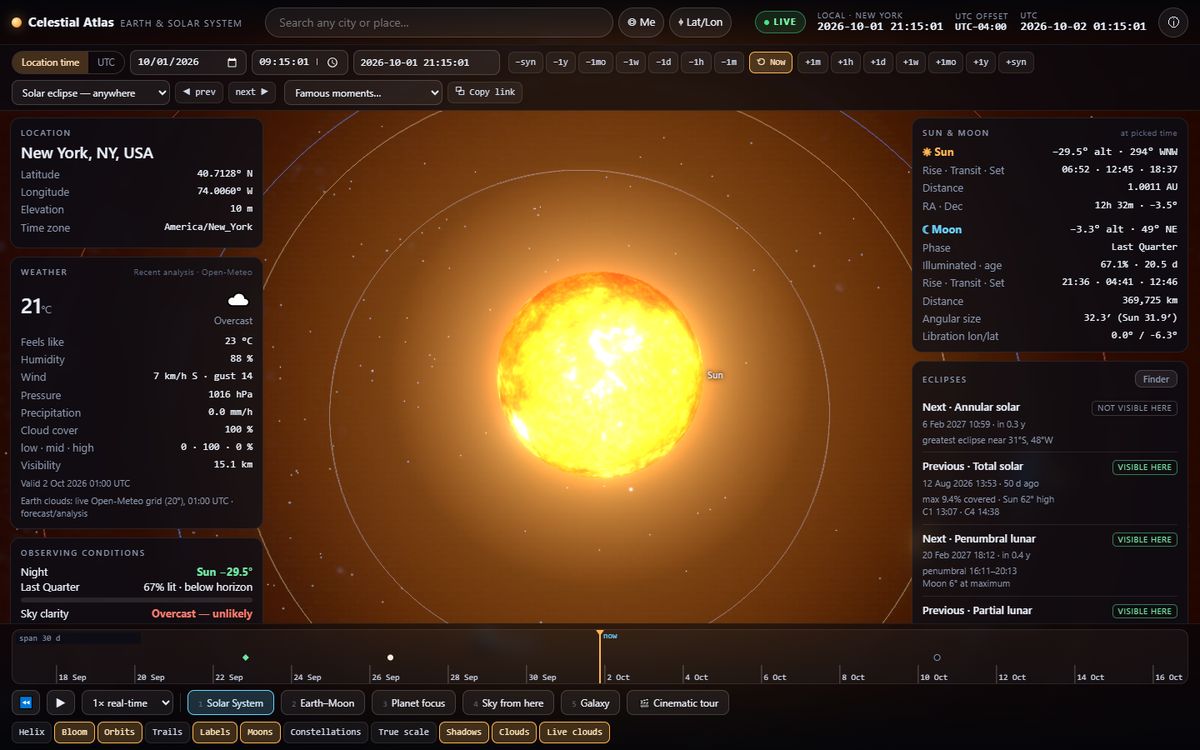
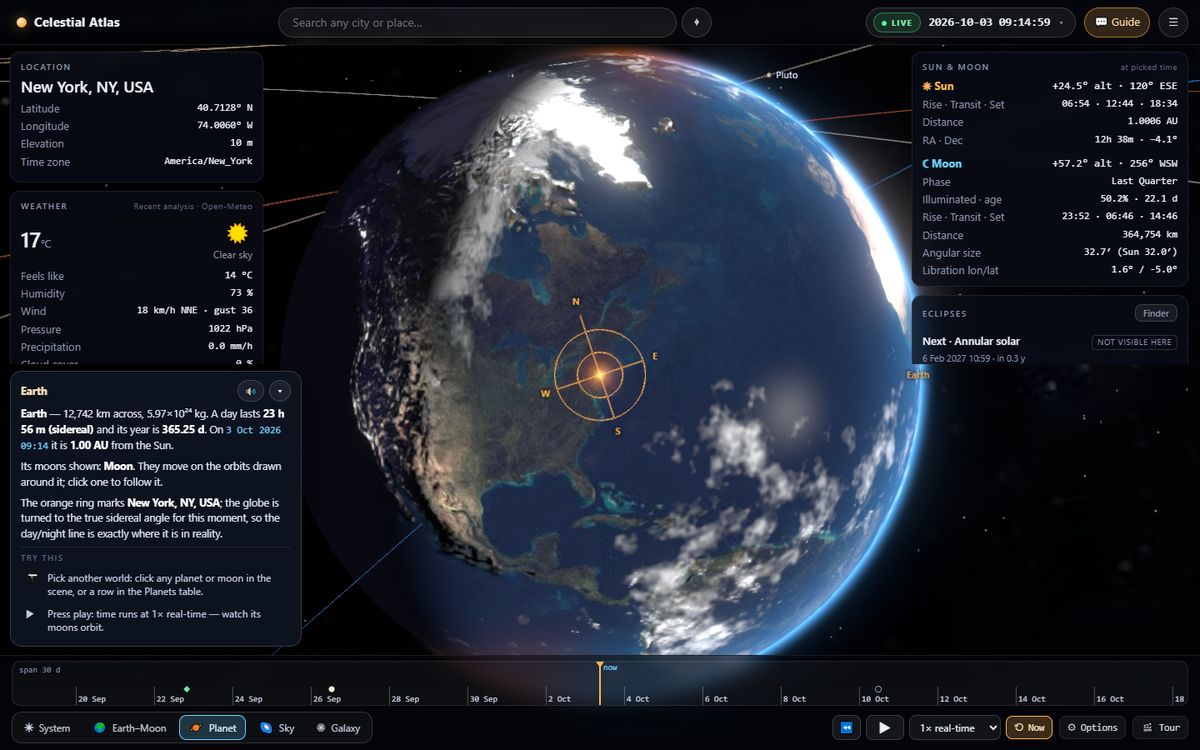
- Interactive 3D solar system: planets, moons and orbits — Interactive 3D solar system showing where the planets, Pluto and 20+ moons really are for any date, with orbits, true-scale mode and a top-down view.
- Time travel: planet and Moon positions for any date from 1000 to 3000 CE — Pick any date from 1000 to 3000 CE and see where the planets, Moon and Sun were or will be, with time zones, daylight saving and accuracy limits explained.
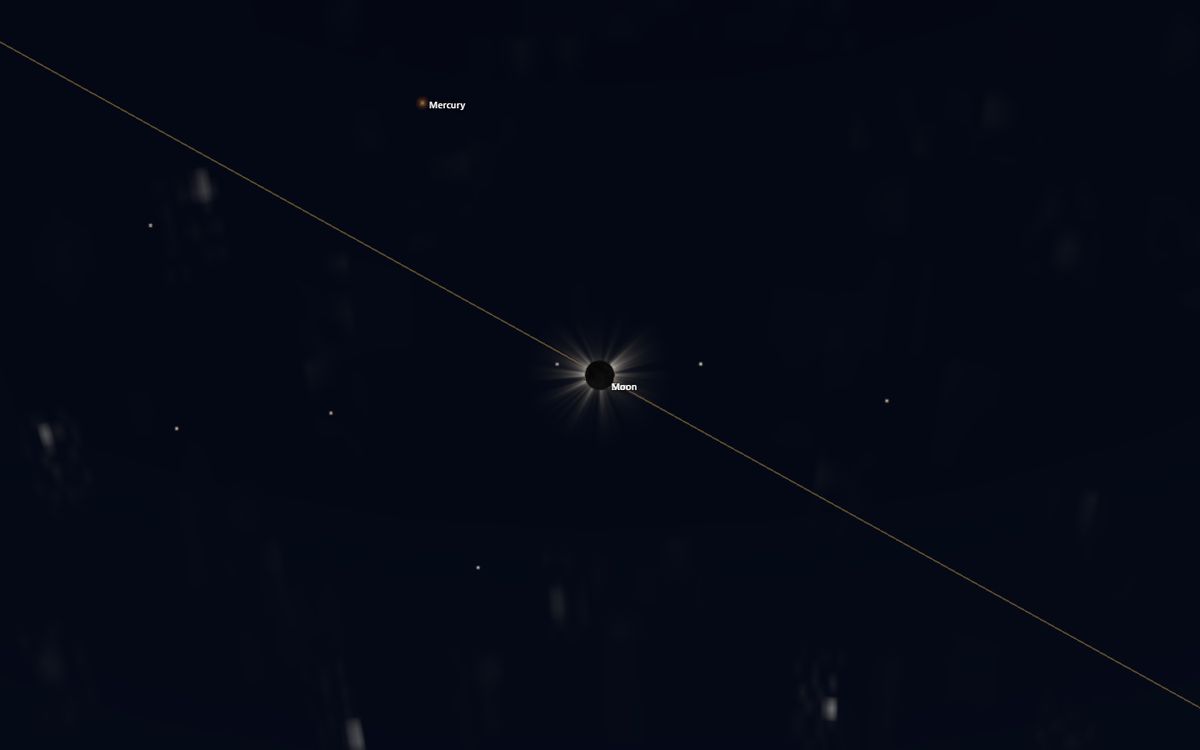
- Solar and lunar eclipses: exact shadows, local times and the 1000–3000 CE catalogue — See solar and lunar eclipses with real shadows, local contact times, totality duration and every eclipse from 1000 to 3000 CE. Find the next one near you.
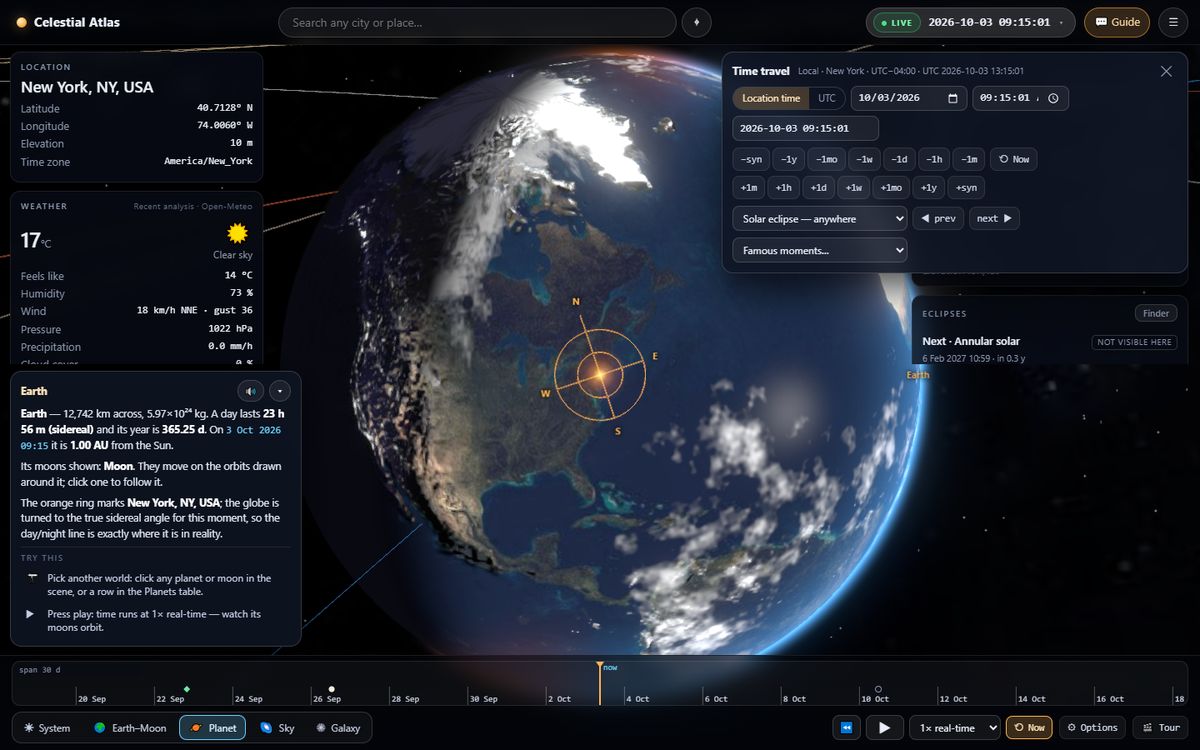
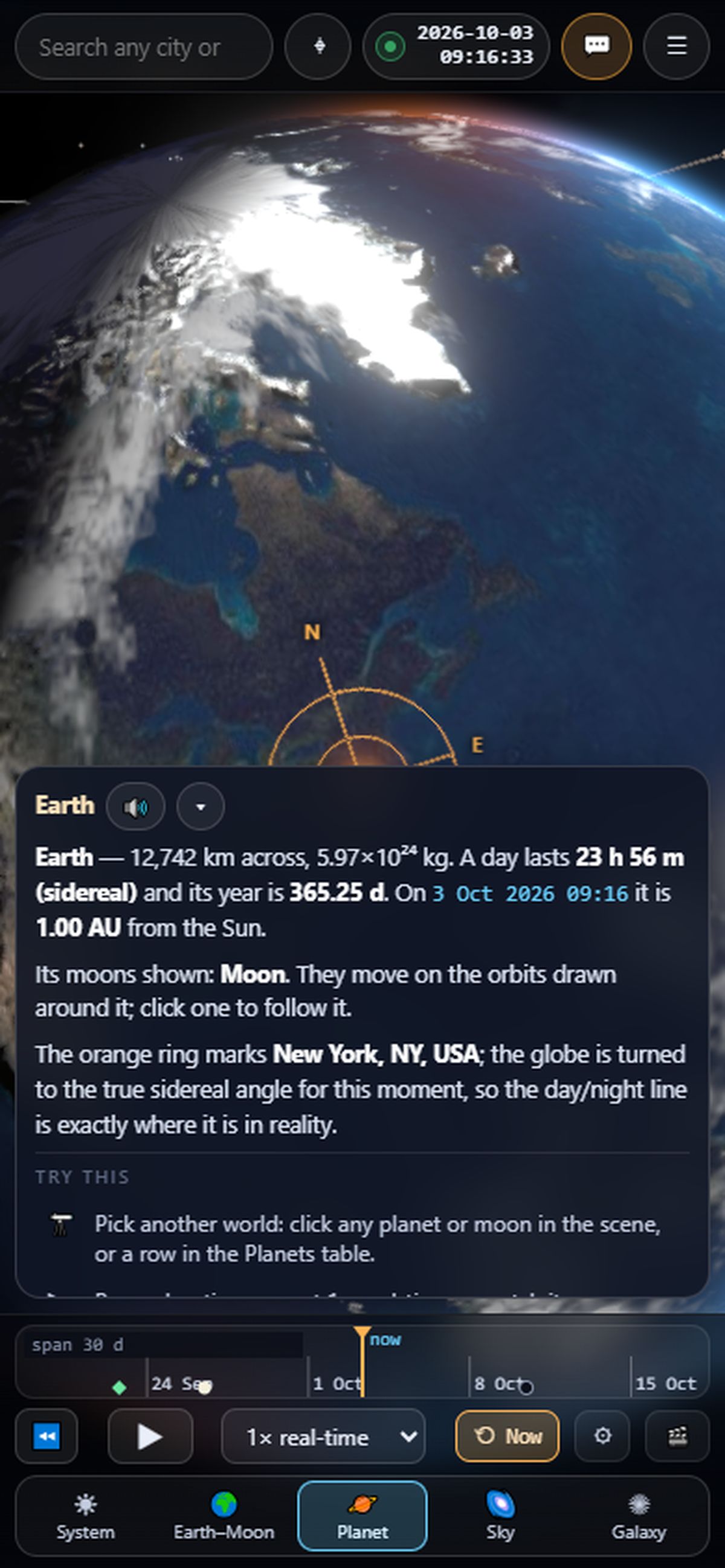
- Earth and the Moon to scale: distance, phases, orbit tilt and libration — See how far the Moon really is (about 30 Earth-widths), why it has phases, how its 5° orbit tilt causes eclipses, and how Earth's day, night and clouds are drawn.
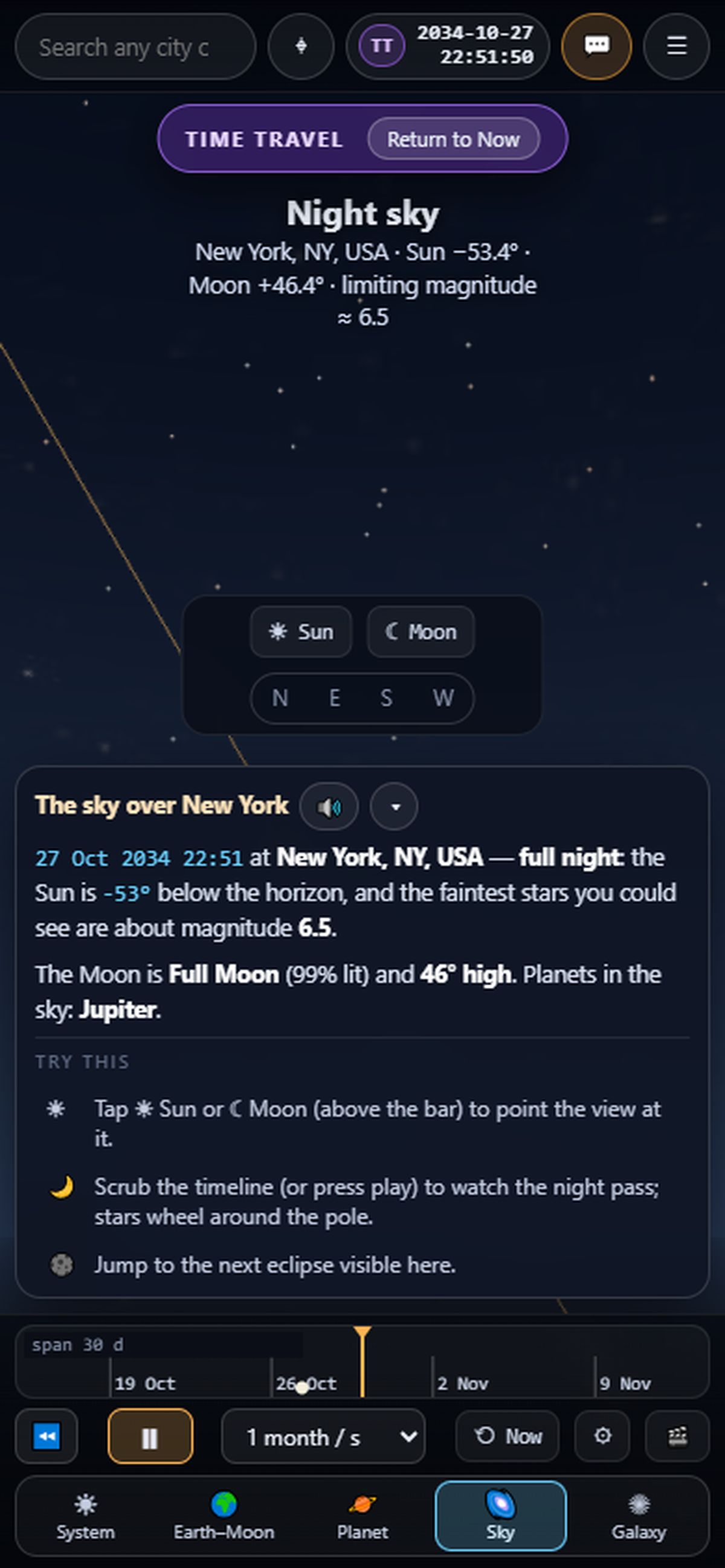
- Sky view: the real sky above any place at any moment — Look up from any city on any date: Sun, Moon, planets and 2,331 stars with proper motion, constellations, twilight stages and eclipses seen from the ground.
- Weather and cloud cover for any date: forecast, history and climatology — How Celestial Atlas shows weather for the place and hour you pick: live forecast, ERA5 history back to 1940, or labelled climatology, plus a live cloud layer.
Our place in the Galaxy
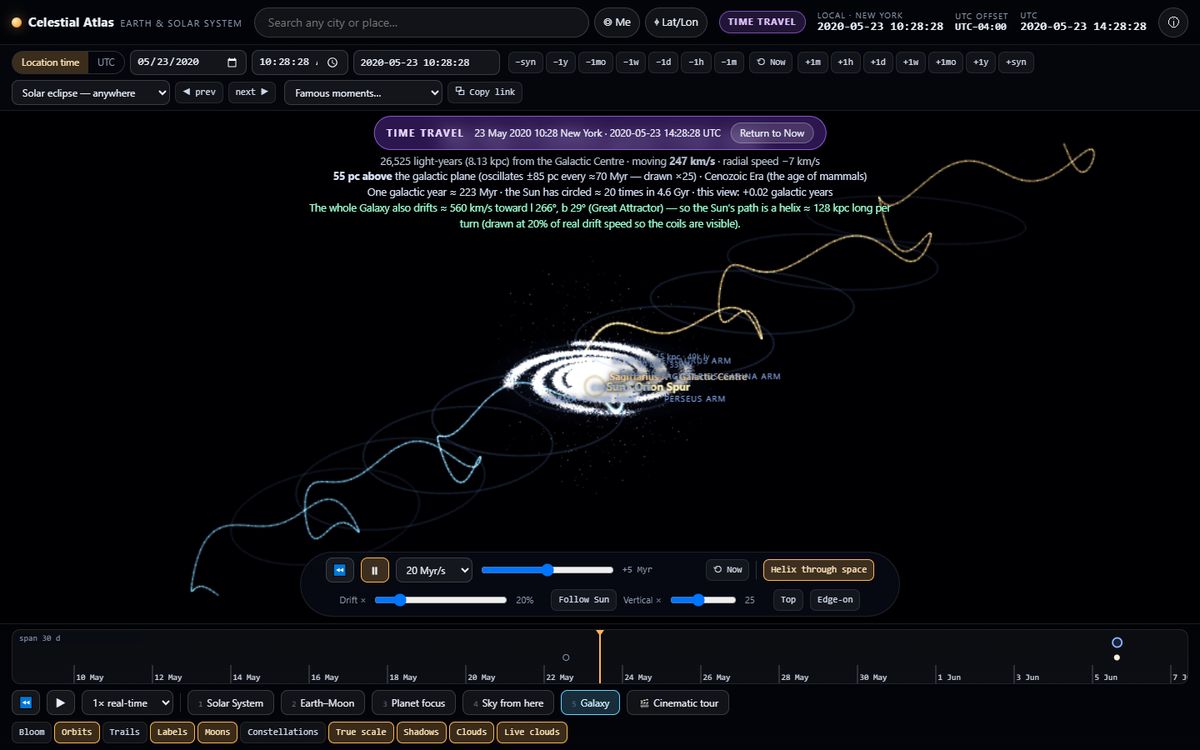
- Does the solar system move in a helix? How the Sun carries the planets through the Galaxy — The Sun moves at about 246 km/s around the Milky Way, so each planet traces a stretched corkscrew. See the helix, its true scale and what 'vortex' videos get wrong.
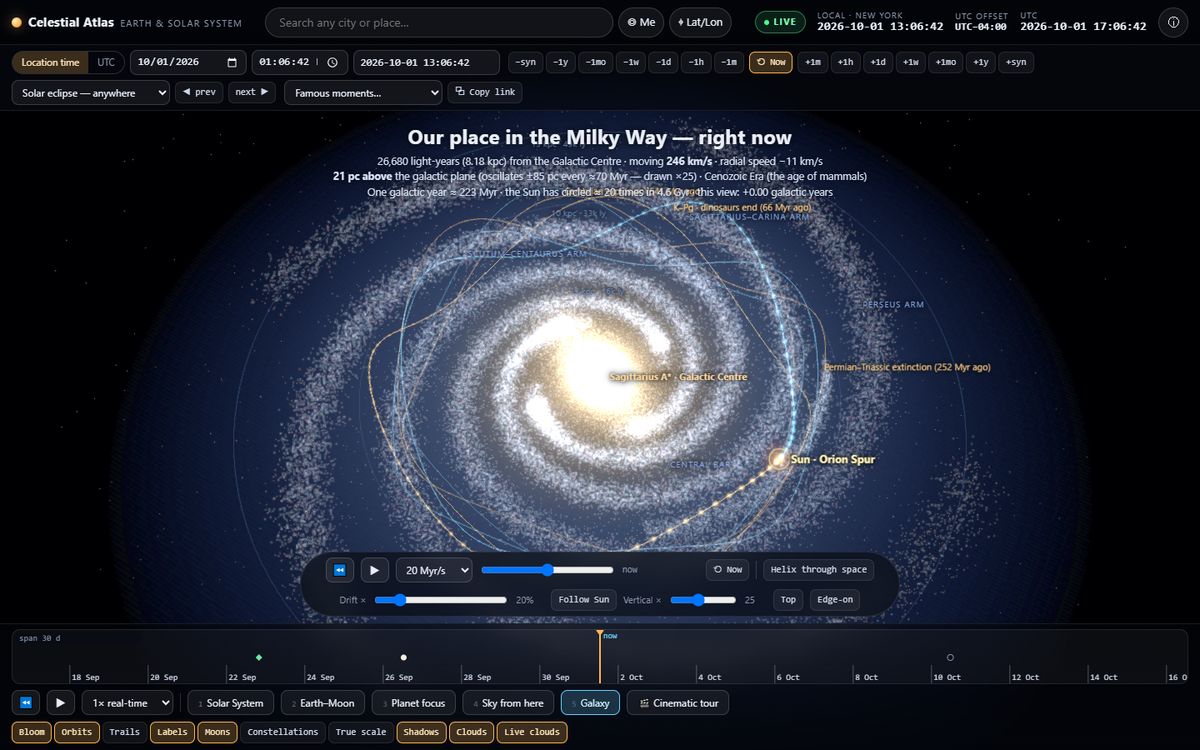
- The Milky Way in 3D: spiral arms, the bar, the bulge and the Sun's orbit — Explore a 3D model of our Galaxy: thin disc, boxy bulge, bar, four spiral arms, warp and halo, and the Sun's 223-million-year orbit with its 70-million-year bobbing.
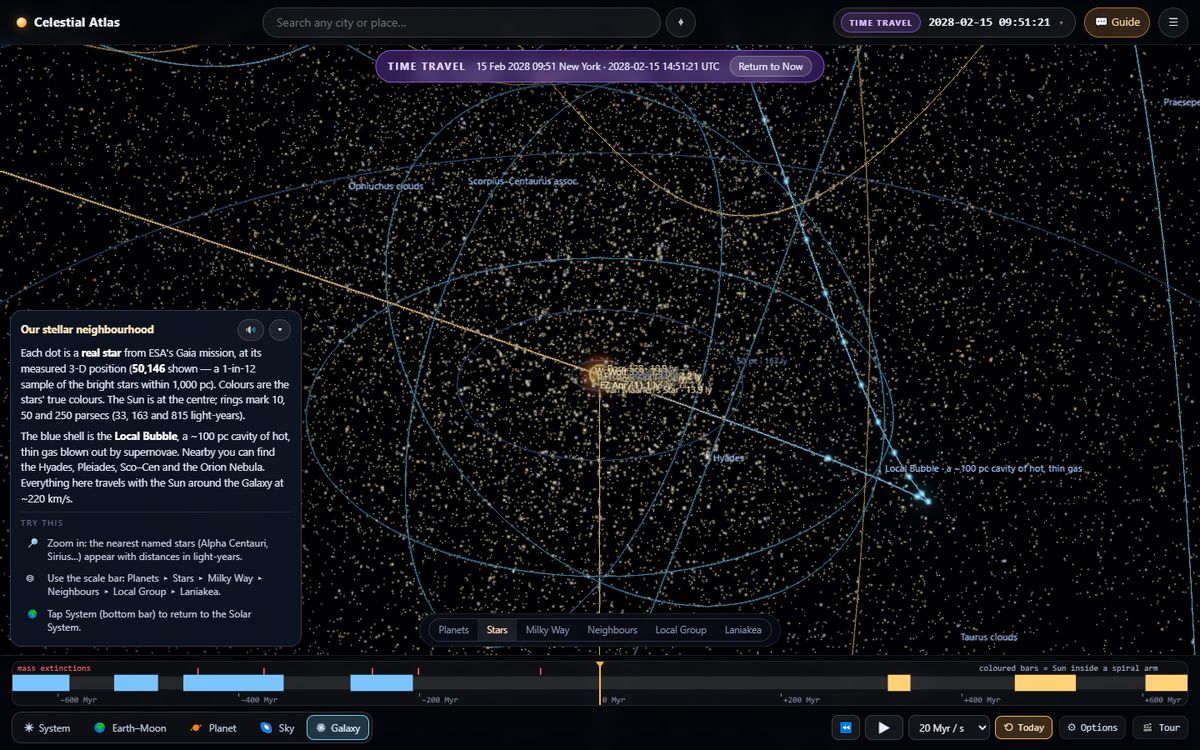
- Real stars around the Sun: Gaia, the Local Bubble and the Gould Belt — Fly through 140,000+ real stars from ESA's Gaia mission at measured 3D positions, with the nearest named stars, the Local Bubble and the Gould Belt.
The wider universe
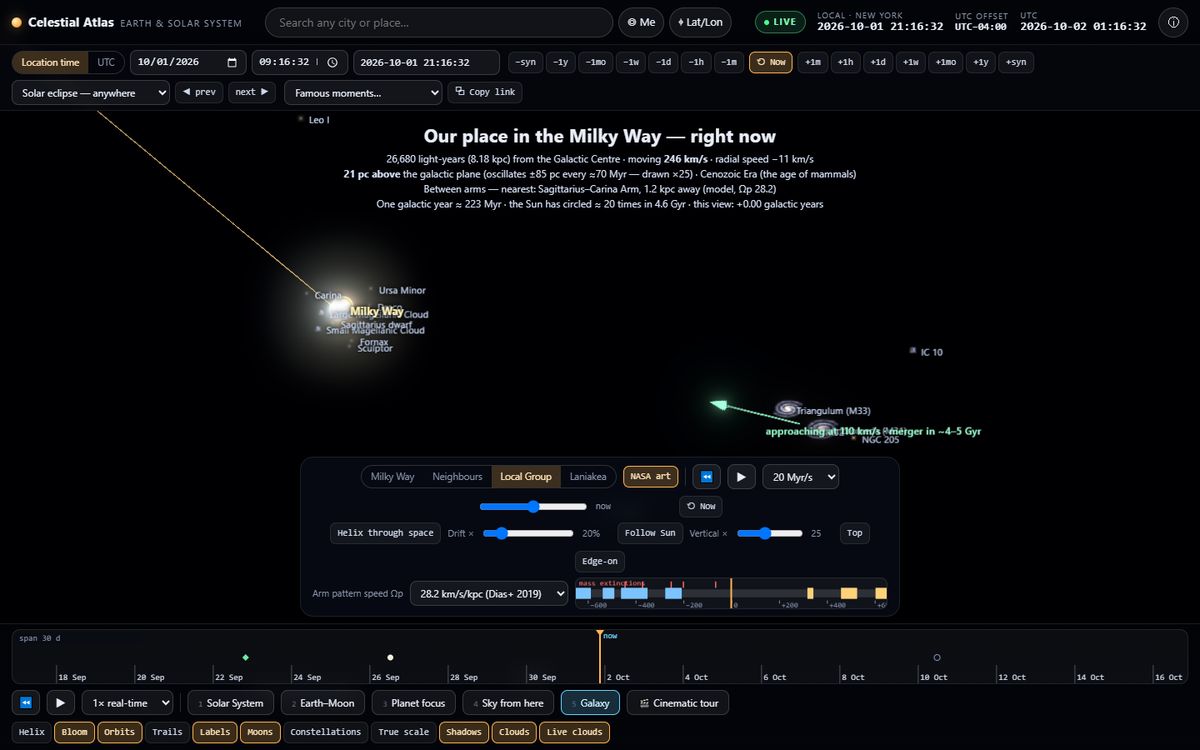
- Andromeda, Triangulum and the Local Group: our neighbours in 3D — Meet the Milky Way's neighbours: the Magellanic Clouds, dwarf galaxies, Andromeda (2.5 million light-years) and Triangulum, drawn in 3D at real tilts and distances.
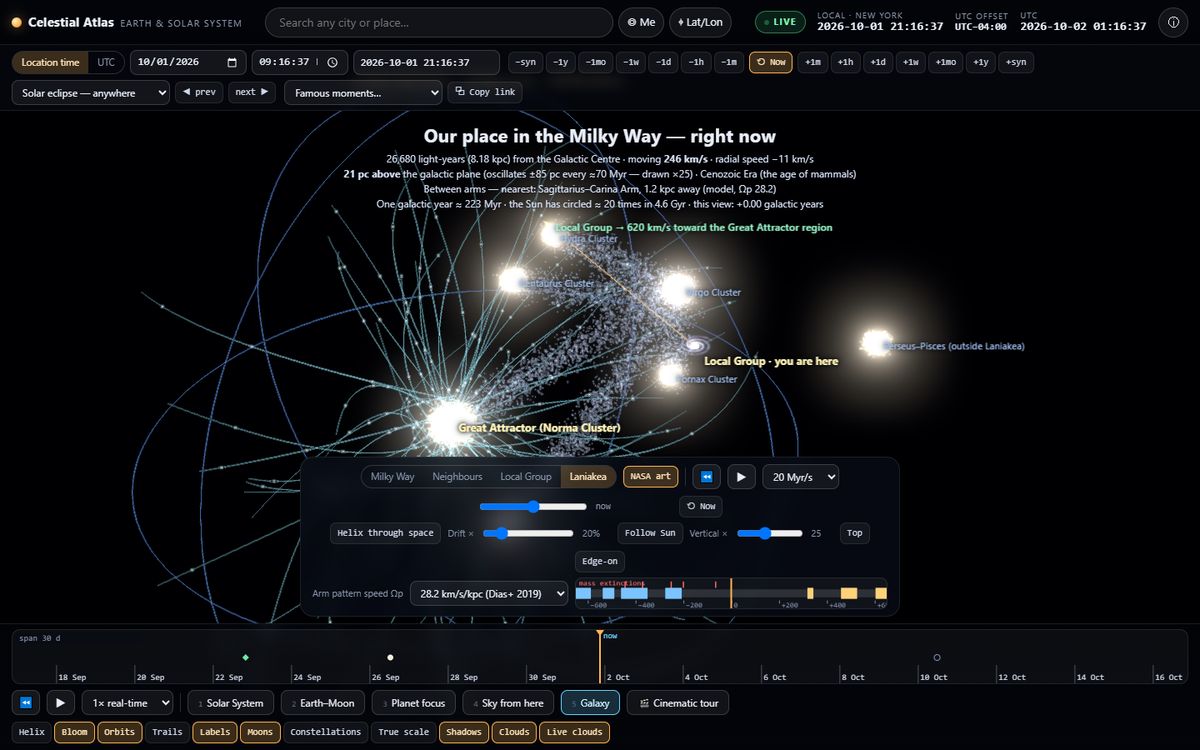
- Laniakea: the supercluster we live in, and the flow to the Great Attractor — Laniakea is the 520-million-light-year region of 100,000 galaxies flowing toward the Great Attractor. See the Local Group's place in it, with streamlines.
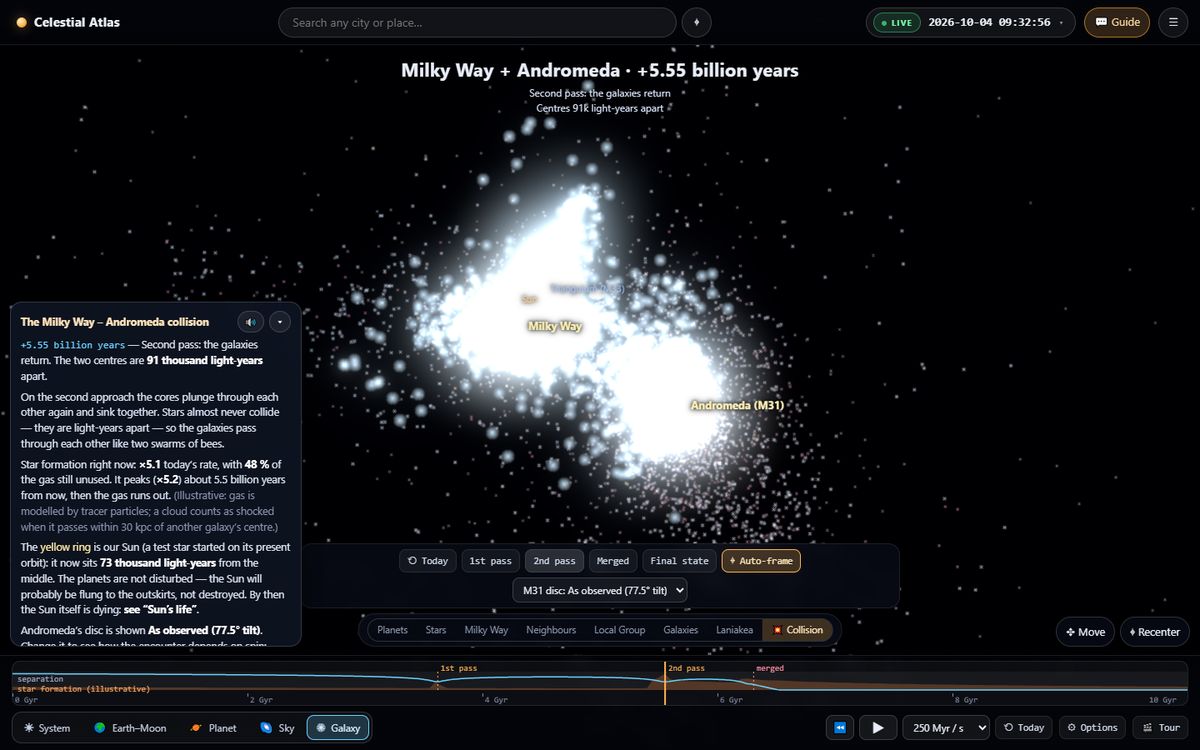
- The Milky Way–Andromeda collision: simulation, timeline and the final merged galaxy — Watch the Milky Way and Andromeda collide over 10 billion years: tidal tails, star-forming gas, the final elliptical 'Milkomeda' and an honest look at its limits.
Time and the Sun
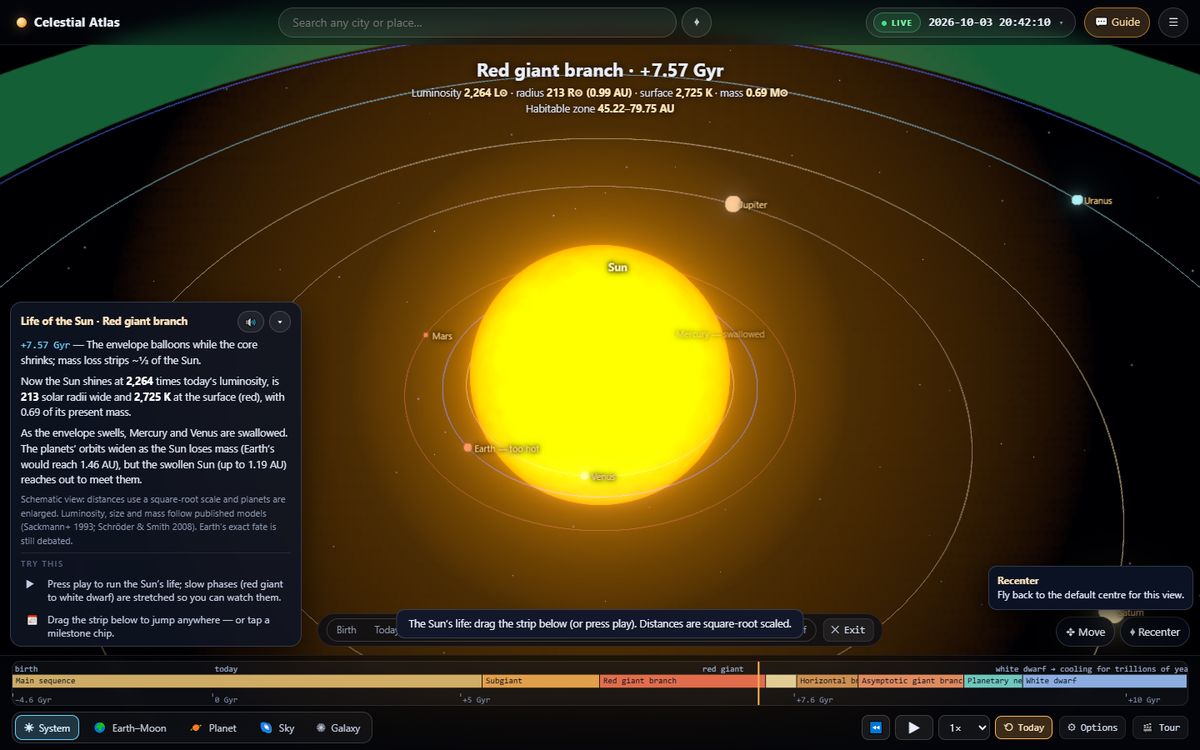
- The life cycle of the Sun: birth, red giant, planetary nebula and white dwarf — Follow the Sun from birth 4.57 billion years ago to a white dwarf: size, brightness and temperature at each stage, when oceans boil away and which planets are lost.
Using and trusting the atlas
- How to use Celestial Atlas: controls, shortcuts and tips — Every control explained: orbit, zoom, pan, the clock and timeline, views, galaxy scales, options, keyboard shortcuts, mobile gestures, share links and languages.
- Data sources, accuracy and credits — Where Celestial Atlas gets planet and Moon positions, stars, weather and textures, how accurate they are against JPL Horizons, and which parts are illustrative.
All topics
Quick answers
What is Celestial Atlas?
Celestial Atlas is a free, open-source, interactive 3D model of Earth, the solar system, the Milky Way and nearby galaxies. It shows where the planets and Moon really are for any date from 1000 to 3000 CE, simulates eclipses, and zooms out to Andromeda and the Laniakea supercluster. Open it or read how to use it.
Does the solar system move in a helix?
In the Galaxy's frame, yes: the Sun carries the planets around the Milky Way at about 246 km/s, so each planet's path is a very stretched corkscrew (about 52 AU long per turn for Earth, but only 1 AU wide). The planets do not trail behind in a wake. Details.
How fast is the solar system moving through space?
About 246 km/s (around 885,000 km/h) around the centre of the Milky Way, and roughly 560 km/s relative to the cosmic microwave background once the Galaxy's own motion is added. Details.
How far is the Sun from the centre of the Milky Way?
About 26,700 light-years (8.18 kiloparsecs), in the Orion Spur between the Sagittarius and Perseus arms. One lap around the Galaxy takes about 223 million years. Details.
When will the Milky Way and Andromeda collide?
Andromeda is approaching at about 110 km/s. Simulations put the first close pass about 4 billion years from now and the final merger at roughly 6–7 billion years; a newer analysis suggests the merger is only about 50% certain within 10 billion years. The atlas simulates the "if it happens" case. Details.
Will stars collide when galaxies merge?
Almost never. Stars are so far apart compared with their sizes that galaxies pass through each other, though gravity flings stars into long tails.