Celestial Atlas › Learn › Real stars around the Sun: Gaia, the Local Bubble and the Gould Belt
Real stars around the Sun: Gaia, the Local Bubble and the Gould Belt
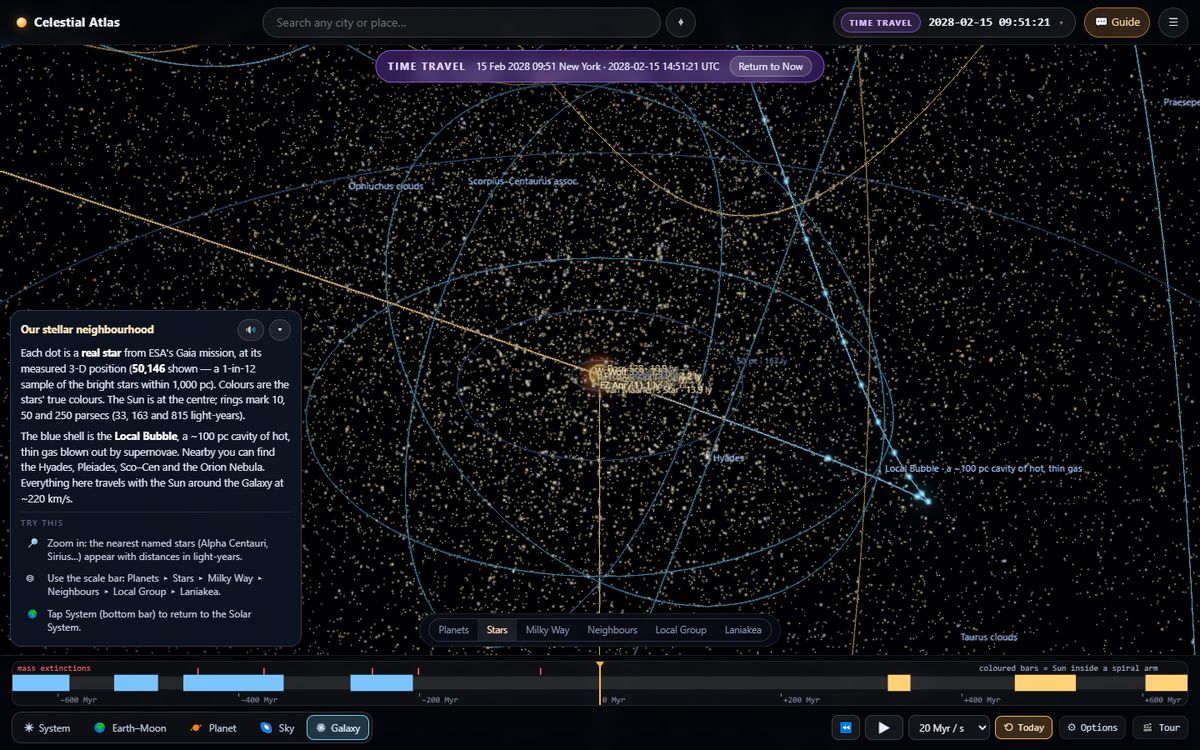
The Stars scale shows real stars from the European Space Agency's Gaia mission, each at the 3D position measured from its parallax: 50,146 bright stars within 1,000 parsecs, 92,385 more within 100 parsecs, and 5,321 young, hot stars that trace the Gould Belt. Colours are the stars' real colours, and you can find the nearest named stars with their distances in light-years.
What Gaia measured
Gaia, launched in 2013, measures the positions, parallaxes and motions of more than a billion stars. A star's parallax — the tiny annual shift in its position as Earth orbits the Sun — gives its distance directly: distance in parsecs = 1,000 / parallax in milliarcseconds. The atlas converts each star's sky position (galactic longitude and latitude) and distance into 3D coordinates and draws it with a colour derived from its BP−RP colour index (blue for hot stars, orange-red for cool ones). The sample is limited to stars with precise parallax (parallax divided by its error above 10) so that the distances you see are trustworthy.
How to explore
Choose Stars in the scale bar. The Sun is at the centre and the camera orbits it; scroll to zoom from about 900 pc down to a few light-years. Rings mark 10, 50 and 250 parsecs (33, 163 and 815 light-years). Zoom to under ≈ 0.4 kpc and the denser 100-pc sample fades in; zoom further and the nearest named stars appear with their distances. Click Options ▸ Young stars to show or hide the Gould Belt layer.
The Local Bubble
The Sun sits inside a roughly 100-parsec cavity of hot, thin gas, the Local Bubble, blown out by a series of supernova explosions over the last ≈ 14 million years. Dense clouds of gas and dust, where new stars form today, lie on its surface: the Taurus, Ophiuchus and Perseus clouds, the Orion Nebula and the Scorpius–Centaurus association appear as labels in the atlas.
The Gould Belt
Young, hot O and B stars are not spread evenly around us: within about 600 parsecs they trace a tilted ring about 700 pc (≈ 2,300 light-years) across, the Gould Belt, inclined roughly 17–20° to the Galactic plane. It contains many of the nearest star-forming regions (Orion, Scorpius–Centaurus, Perseus, Taurus) and the Sun lies near its centre. In the atlas the belt is revealed by 5,321 real Gaia stars that are intrinsically luminous and hot. Some astronomers now interpret it as part of a larger wave-like structure of gas called the Radcliffe Wave; the atlas simply shows the stars.
Limits of the sample
- Real Every plotted star is a real Gaia star at its measured position and colour.
- Illustrative The samples are random subsets (1-in-12 and 1-in-4) chosen to keep the page fast, and the young-star cut is on absolute magnitude, so some old or reddened stars and many fainter young stars are missing; the density you see is a fraction of the true one.
- Illustrative Interstellar dust is not drawn, so reddened stars can look redder than they would otherwise.
Frequently asked questions
How many real stars does the atlas show?
Over 140,000 Gaia stars: 50,146 within 1 kpc (a 1-in-12 sample), 92,385 within 100 pc (a 1-in-4 sample) and 5,321 young hot stars out to 650 pc.
What are the nearest stars to the Sun?
Proxima Centauri (4.25 light-years), Alpha Centauri A and B (4.37), Barnard's Star (5.96), Wolf 359 (7.9) and Sirius (8.6).
What is the Local Bubble?
A cavity about 100 parsecs wide filled with hot, low-density gas, carved by supernovae over the last ~14 million years, with the Sun inside it.
What is the Gould Belt?
A ring of young stars and star-forming clouds about 2,300 light-years across, tilted ~17–20° to the Galactic plane, with the Sun near its middle.