Celestial Atlas › Learn › Solar and lunar eclipses: exact shadows, local times and the 1000–3000 CE catalogue
Solar and lunar eclipses: exact shadows, local times and the 1000–3000 CE catalogue
A solar eclipse happens when the Moon's shadow falls on Earth; a lunar eclipse when the Moon passes into Earth's shadow. Celestial Atlas computes both from the real positions of the Sun, Earth and Moon, draws the shadows pixel by pixel, lists the contact times for your location and includes every one of the 9,641 eclipses between 1000 and 3000 CE.
Why eclipses happen (and why not every month)
The Moon orbits Earth every 27.3 days and goes through its phases every 29.5 days, so there is a New Moon (when it could block the Sun) and a Full Moon (when it could enter Earth's shadow) every month. But the Moon's orbit is tilted about 5° to Earth's, so most months the Moon passes above or below the line between Sun and Earth. Eclipses occur only when a New or Full Moon happens near one of the two points where the orbits cross, the nodes. That gives between two and five solar eclipses a year, and eclipses repeat in families: the Saros cycle of 18 years 11 days 8 hours.
Solar eclipses: total, annular, partial, hybrid
| Type | What happens |
|---|---|
| Total | The Moon is close enough (large enough in the sky) to cover the whole Sun; observers in the narrow umbra see totality and the corona. Totality never lasts longer than about 7½ minutes. |
| Annular | The Moon is near apogee and looks too small to cover the Sun; a “ring of fire” remains. |
| Partial | Only part of the Sun is covered, seen from within the penumbra. |
| Hybrid | Annular for some observers and total for others along the same path. |
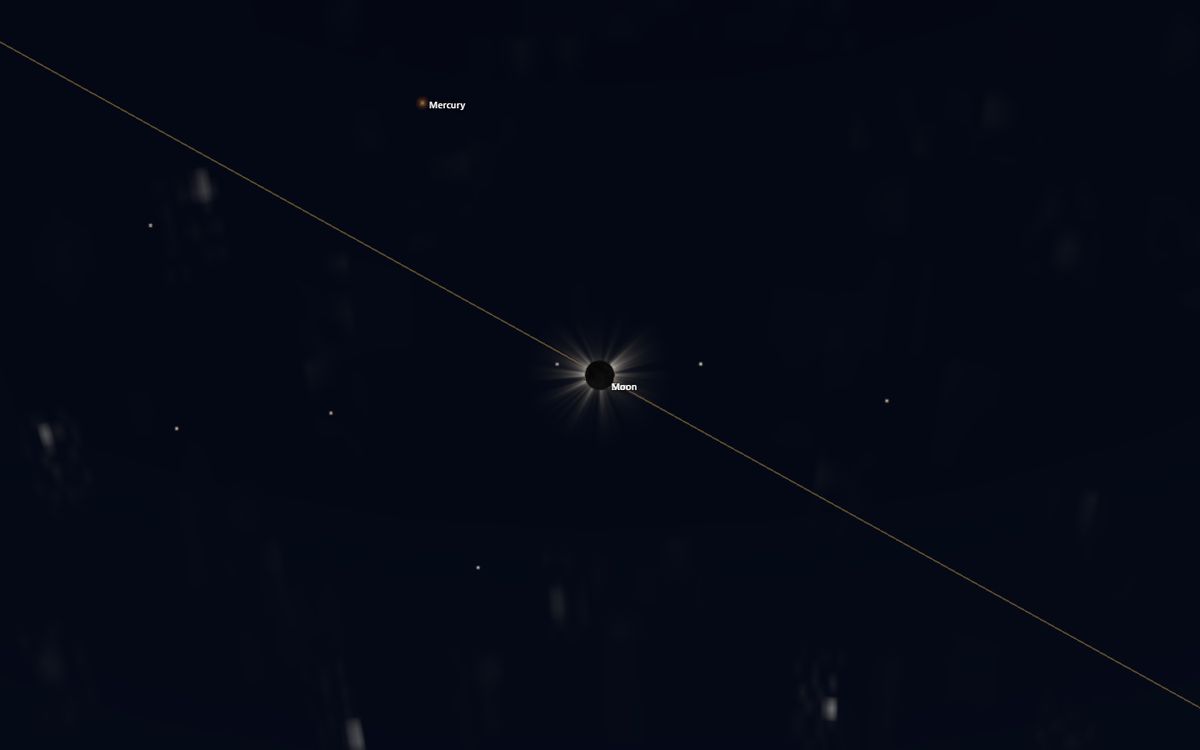
In the atlas, the Eclipses card lists the previous and next solar eclipse with its type, whether it is visible from your location, and (when visible) the local first contact (C1), start and end of totality (C2, C3) and last contact (C4), the maximum obscuration and the Sun's altitude. Open the Sky view during an eclipse and the Sun shows the correct bite, with the sky brightness falling the way it does in reality, the corona appearing at totality and the “diamond ring” at the edges.
Examples built in: 21 August 2017 (Carbondale, Illinois), 8 April 2024 (Dallas, Texas — totality about 4 minutes), 12 August 2026 (Spain) and 2 August 2027 (Luxor, Egypt — among the longest totalities of the century, over 6 minutes).
Lunar eclipses and the “blood Moon”
In a lunar eclipse the Moon enters Earth's penumbra (a subtle dimming), then the dark umbra (a partial or total eclipse). In totality the Moon is not black but copper-red, because sunlight bent through Earth's atmosphere still reaches it — in effect all of Earth's sunrises and sunsets projected onto the Moon. The atlas shows the Moon's face crossing the shadow with the red glow, and lists penumbral, partial and total phase times and the Moon's altitude at maximum for your location. Total lunar eclipses are visible from the entire night side of Earth, which is why they are seen far more often at a given place than total solar eclipses. Built-in examples: total 7 September 2025 and partial 28 August 2026.
How the shadows are drawn
For every pixel on a body, the shader works out how much of the Sun's disc is hidden by an occluding body, treating Sun and occluder as overlapping discs as seen from that point. That gives smooth penumbras and the correct red-tinted umbra on the Moon. The same code produces Io's shadow on Jupiter, Jupiter's moons disappearing into Jupiter's shadow, and the shadows of Saturn's rings and globe. At True scale you can also switch on the umbra and penumbra cones and watch the Moon's shadow sweep across Earth.
Finding eclipses
The Eclipse finder (menu) lists every eclipse in a window of 10 to 100 years around the selected time, flags which are visible from your place, and jumps to any entry. The dock timeline also marks eclipses as amber (solar) and ringed (lunar) dots over 500 years, using a precomputed table so it appears instantly.
What is real and what is illustrative
- Real Eclipse dates, types and times, contact times, magnitudes and obscurations (checked against the 2017, 2024, 2025, 2026 and 2027 events).
- Real The geometry of the shadow cones and the Moon's apparent size.
- Illustrative The corona's shape (a stylised model, not the actual corona of that day) and the sky-brightness curve during totality.
- Illustrative Time precision before about 1600 or after 2100 CE, because of uncertainty in Earth's rotation (ΔT).
Frequently asked questions
When is the next total solar eclipse?
The atlas lists it for you: open the Eclipses card or choose “Solar eclipse — anywhere” in the time-travel panel and press next. Totals fall on 12 August 2026 (Spain, Iceland) and 2 August 2027 (Egypt, Saudi Arabia) among others.
Why is the Moon red during a total lunar eclipse?
Earth's atmosphere bends red sunlight into the shadow and scatters blue light away, so the Moon is lit by the combined sunrises and sunsets of the world, giving a copper-red glow.
How long can a total solar eclipse last?
At most about 7 minutes 32 seconds at one place; typical totalities are 2 to 4 minutes. Around 2 August 2027 near Luxor the atlas shows over 6 minutes.
Can I see eclipses from the past, like 1919?
Yes. Choose the Eddington 1919 preset and the atlas places you at Príncipe at the time of the eclipse used to test general relativity.