Celestial Atlas › Learn › Earth and the Moon to scale: distance, phases, orbit tilt and libration
Earth and the Moon to scale: distance, phases, orbit tilt and libration
The Moon is on average 384,400 km from Earth — about 30 Earth diameters — and almost every picture of the pair is wrong about that. The Earth–Moon view shows them to true scale, with Earth turned to its real orientation for the chosen moment and the Moon in its real phase, orbit tilt and libration.
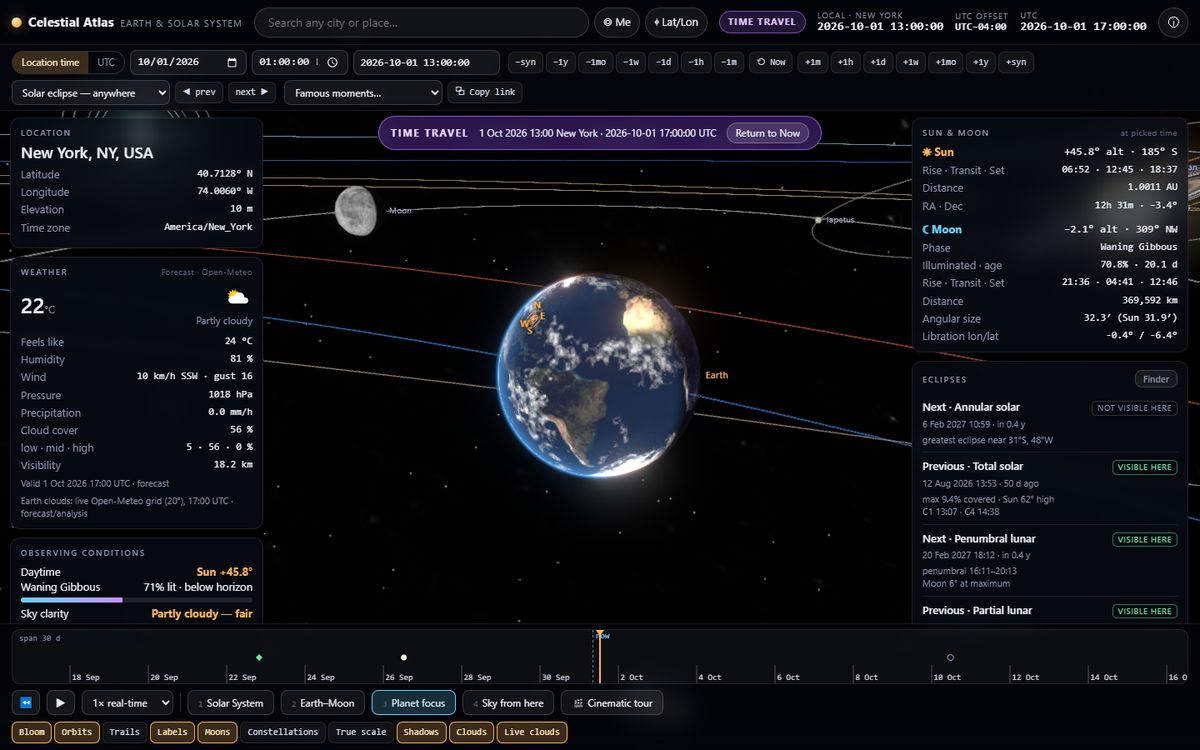
How far is the Moon, really?
If you lined up the other seven planets side by side (their diameters add up to about 380,000 km) they would only just fit in the gap between Earth and the Moon. In the Earth–Moon view the scale is fixed at 1 scene unit = 1,000 km: Earth is 12.7 units wide, and the Moon sits about 384 units away. Zooming from Earth to the Moon takes long enough to feel the distance. The Moon's distance changes by about ±6% during its elliptical orbit: at perigee it looks about 14% bigger than at apogee, which is why “supermoons” and annular eclipses happen.
Why the Moon has phases
Half the Moon is always lit by the Sun; what changes is how much of that lit half we can see. At New Moon the lit side faces away from us; at Full Moon we see all of it. The atlas shades the Moon from the true Sun direction, names the phase (New, Waxing Crescent, First Quarter, Waxing Gibbous, Full, Waning Gibbous, Last Quarter, Waning Crescent), and gives the illuminated percentage and age in days for any date.
Orbit tilt and why there is not an eclipse every month
Because the Moon's orbit is tilted about 5° the Moon is usually north or south of the Sun–Earth line. The atlas tells you how many degrees north or south of the plane the Moon currently is, and whether that is close enough to the plane for an eclipse at the coming New or Full Moon.
Libration: a wobbling Moon
The Moon always shows nearly the same face, but not exactly: its elliptical orbit speeds up and slows down while its rotation is steady (libration in longitude, up to about 7.9°), and its axis is slightly tilted to its orbit (libration in latitude, up to about 6.7°). Over time we see about 59% of the surface. The atlas applies the real libration angles to the Moon's texture.
Earth as depicted
- Real Orientation: Earth is turned to the exact sidereal angle, so the day/night line is where it is in reality for the moment you chose; seasons follow from the 23.4° tilt.
- Real City lights on the night side, the daylight terminator and twilight band.
- Illustrative Surface imagery (NASA Visible Earth composites), the relief shading and the atmosphere glow are stylised for beauty.
- Real Clouds: a live cloud grid for the chosen hour (see weather and clouds) or a static texture.
A marker with a local-horizon grid and compass shows your selected place.
Frequently asked questions
How far away is the Moon compared with Earth's size?
About 30 Earth diameters: 384,400 km on average versus Earth's 12,742 km width.
Why do we always see the same side of the Moon?
The Moon is tidally locked: it rotates once per orbit (27.3 days). Libration lets us see about 59% of its surface over time.
Is the day/night line in the atlas accurate?
Yes. Earth is rotated to the true sidereal angle for the selected time, so the terminator and the Sun's direction match reality.