Celestial Atlas › Learn › Sky view: the real sky above any place at any moment
Sky view: the real sky above any place at any moment
The Sky view is a planetarium for your place and chosen moment. It shows the Sun, Moon, planets and 2,331 stars at their real altitude and azimuth, draws the constellations, and darkens or brightens the sky according to how far the Sun is below the horizon — including during an eclipse.
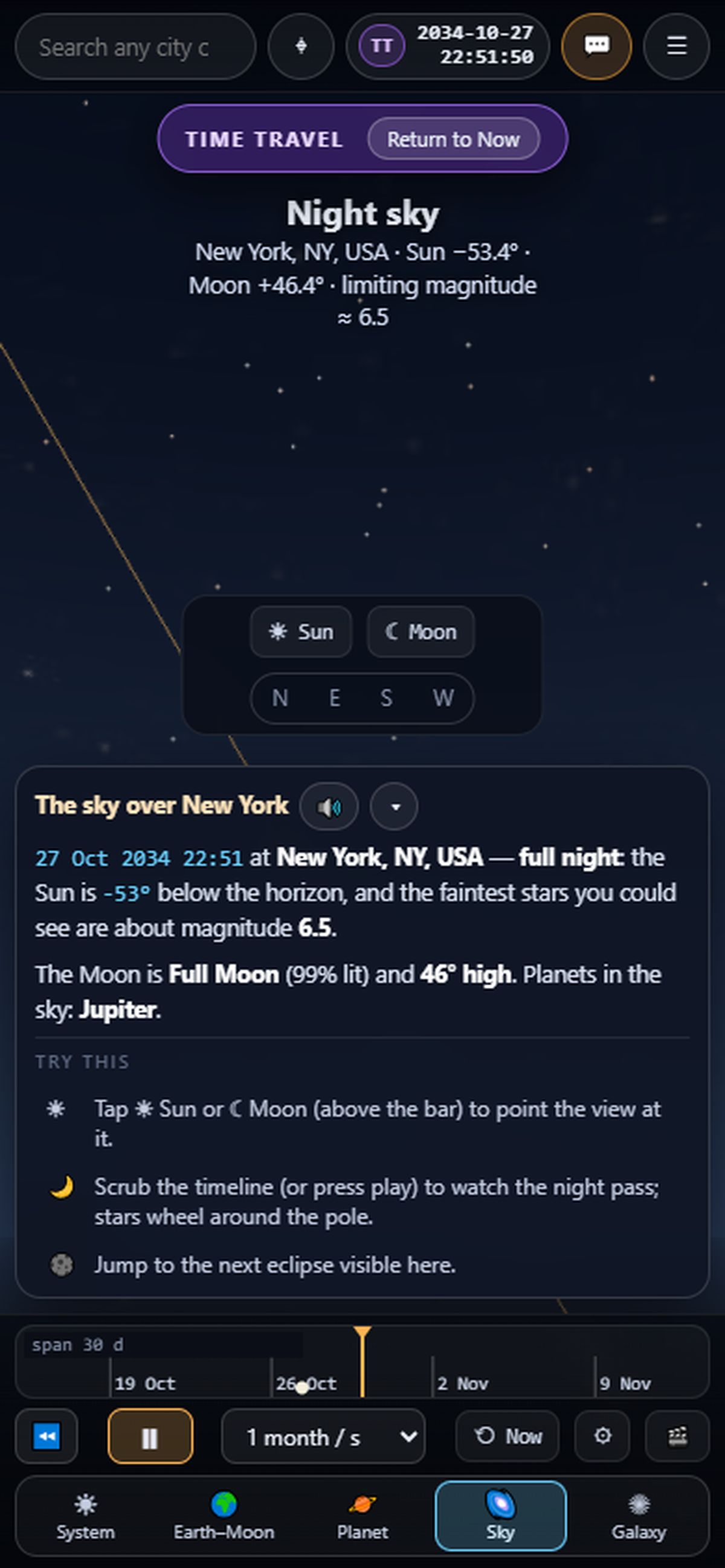
What you are looking at
Imagine lying on your back at the chosen place: the horizon is the edge of the picture, north is marked N, and the zenith is straight up. Drag to look around, scroll or pinch to zoom the field of view from 110° down to 2°, and tap ☀ Sun or ☾ Moon to aim at them. The info line tells you what the sky is doing: daytime, civil, nautical or astronomical twilight, or full night.
Twilight stages
| Stage | Sun's altitude | What you can see |
|---|---|---|
| Civil twilight | 0° to −6° | Brightest planets and stars appear; horizon clear. |
| Nautical twilight | −6° to −12° | Many stars visible; horizon fading. |
| Astronomical twilight | −12° to −18° | Sky almost dark; faint stars appear. |
| Night | below −18° | Fully dark (if no Moon or city light). |
The atlas also estimates the limiting magnitude — the faintest star you could see — which is about 6.5 on a dark moonless night and brightens to negative values in daylight.
Planets tonight
The “Up tonight” card lists which planets rise above 8° during the night, when they are up and their maximum altitude, and marks those visible to the naked eye. In the Planets table a ✔ means above the horizon in a dark sky and bright enough; ☼ means up but in daylight or twilight. All positions are topocentric — computed for your actual location, not Earth's centre.
Stars and constellations
The star catalogue is the Hipparcos-derived HYG database filtered to naked-eye stars (2,331). Because stars move, each is shifted by its proper motion to the chosen date — Sirius moves about 0.36° over the 974 years between 1000 and 1974 CE — and then precessed to the date's equinox, so the sky of 1000 CE differs subtly from today's. Constellation lines come from the d3-celestial data set (IAU boundaries and names).
Eclipses from the ground
During a solar eclipse the Sun is drawn with the Moon's correct bite, the sky darkens by the correct amount, and at totality the corona and the “diamond ring” appear; during a lunar eclipse the Moon dims and reddens. See solar and lunar eclipses.
What is real and what is illustrative
- Real Positions of Sun, Moon, planets and stars; rise/set times; twilight definitions.
- Illustrative The glow of the sky and the star-twinkle styling; the Milky Way band is a texture, not a per-date model; no light pollution or horizon obstructions are modelled.
Frequently asked questions
What planets are visible tonight?
Open the Sky view or the Up tonight card for your location: it lists the planets above 8° during the night and which are bright enough to see with the naked eye.
Does the sky view account for atmospheric refraction?
Not yet: rise and set times are geometric. Refraction near the horizon, which lifts objects by about 0.5°, is on the roadmap.
Can I see the sky from my birth date?
Yes: use “My birth sky” in the time-travel panel, or set the date manually and open the Sky view.