Celestial Atlas › Learn › The Milky Way in 3D: spiral arms, the bar, the bulge and the Sun's orbit
The Milky Way in 3D: spiral arms, the bar, the bulge and the Sun's orbit
The Milky Way is a barred spiral galaxy about 100,000 light-years across but only about 1,000 light-years thick, with the Sun 26,700 light-years from the centre. Celestial Atlas builds it as a true three-dimensional cloud of stars, so seen edge-on it is a thin, bulging, slightly warped disc — not a flat picture — and shows the Sun's real orbit through it.
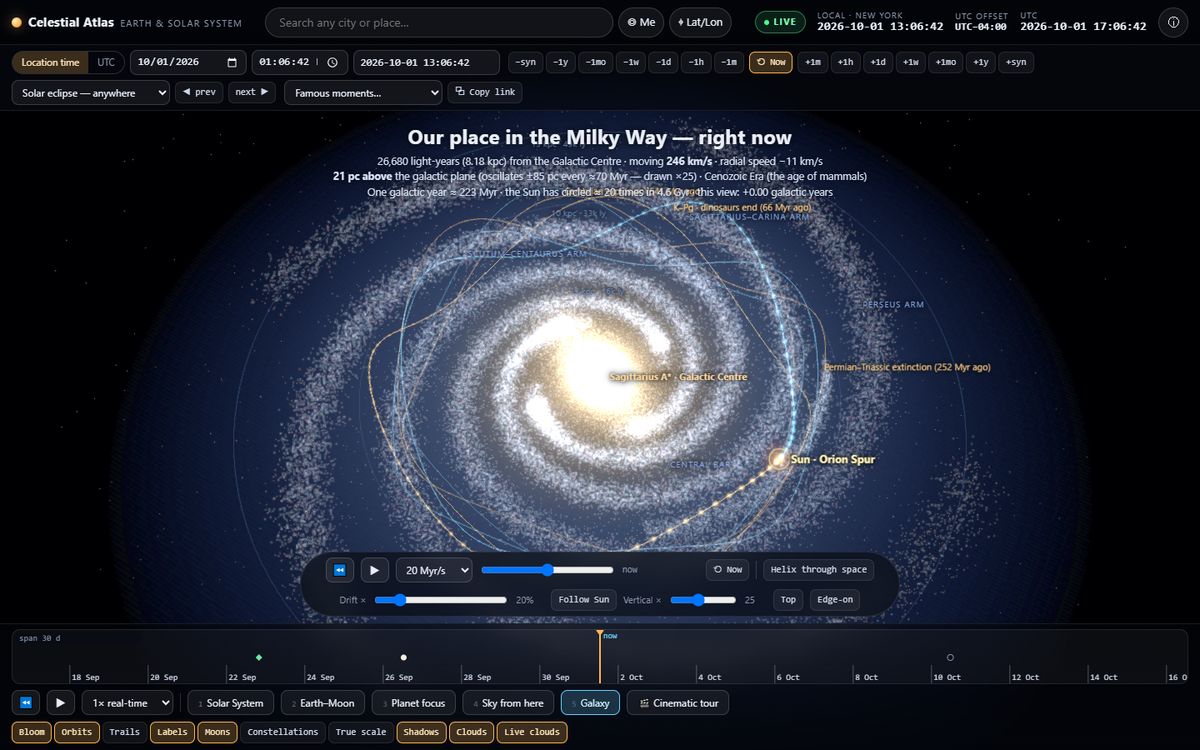
The shape of the Galaxy
The model contains the components astronomers identify from surveys and from comparison with other galaxies:
- Thin disc — young stars, gas and dust, a scale height of ≈ 300 pc that flares outward (thicker at the edge).
- Thick disc — older stars with a scale height of ≈ 900 pc.
- Bulge and bar — a boxy/peanut-shaped bulge of old stars and a bar with a half-length of ≈ 4.6 kpc inclined ≈ 27° to the Sun–centre line.
- Spiral arms — four logarithmic arms with a pitch of ≈ 13°: Perseus, Sagittarius–Carina, Scutum–Centaurus and Norma–Outer. The Sun lies in a minor spur, the Orion Spur (Local Arm), between the Sagittarius and Perseus arms.
- Warp — the outer disc bends up on one side and down on the other.
- Halo — a sparse, roughly spherical cloud of old stars and globular clusters, embedded in a much more massive halo of dark matter (not drawn).
Press Edge-on view in Options to see the thin disc, the central bulge and the warp from the side. An optional NASA/JPL artist's concept is painted underneath and fades out edge-on so the true 3D shape shows.
The Sun's orbit
The Sun orbits the centre at about 233 km/s (circular speed at its radius) plus its own small peculiar motion, in a path that is nearly a circle with slow in-and-out and up-and-down oscillations. The atlas integrates the orbit numerically in a potential with a flat rotation curve: a lap takes ≈ 223 Myr, the distance from the centre varies between ≈ 8.1 and 9.2 kpc, and the height above the plane oscillates with a period of ≈ 70 Myr and an amplitude of ≈ 85 pc. The vertical motion is exaggerated by a slider (×25 by default) so that you can see it. Scrub ±650 million years with the strip at the bottom: the K–Pg extinction (66 Myr ago, end of the dinosaurs), the Permian–Triassic extinction (252 Myr ago) and the Cambrian explosion (541 Myr ago) are marked for orientation. No causal link between the Sun's position and these events is claimed.
Spiral arms and the arm-crossing strip
The arms are density waves rotating at a pattern speed different from the stars' orbital speed. Using a pattern speed Ωp (28.2 km/s/kpc by default, from Dias et al. 2019; alternatives 20, 25 and 32 are selectable), the atlas computes when the Sun's path enters and leaves each arm and draws coloured bars on the galactic-time strip. The bars are a model: the true pattern speed and arm positions are uncertain, so treat the crossing times as illustrative.
Reading the labels
- Sagittarius A* — the supermassive black hole at the centre.
- Rings at 5, 10 and 15 kpc (16,000, 33,000 and 49,000 light-years) help judge distance.
- The yellow ring marks the Sun; the blue trail is its past, the orange its future.
What is real and what is illustrative
- Real The Sun's distance from the centre (8.18 kpc), circular speed, peculiar velocity, vertical oscillation and the size, thickness and bar angle of the Galaxy.
- Illustrative The individual stars are generated (about 110,000 points) to follow those structures; they are not a catalogue. The detailed arm positions and the pattern speed are uncertain. Dust lanes are schematic. For real stars see Gaia stars near the Sun.
Frequently asked questions
Where is the Sun in the Milky Way?
About 26,700 light-years from the centre, in the Orion Spur between the Sagittarius and Perseus spiral arms, roughly 20 parsecs north of the Galactic plane.
How long does the Sun take to orbit the Galaxy?
About 223 million years, so it has made around 20 laps since it formed 4.57 billion years ago.
How big is the Milky Way?
The stellar disc is about 100,000 light-years across and about 1,000 light-years thick; including the faint halo it is larger.
Is the Milky Way flat?
It is thin, not flat: about 100 times wider than thick, with a bulging centre and a warped outer disc. The atlas models that 3D shape.