Celestial Atlas › Learn › Andromeda, Triangulum and the Local Group: our neighbours in 3D
Andromeda, Triangulum and the Local Group: our neighbours in 3D
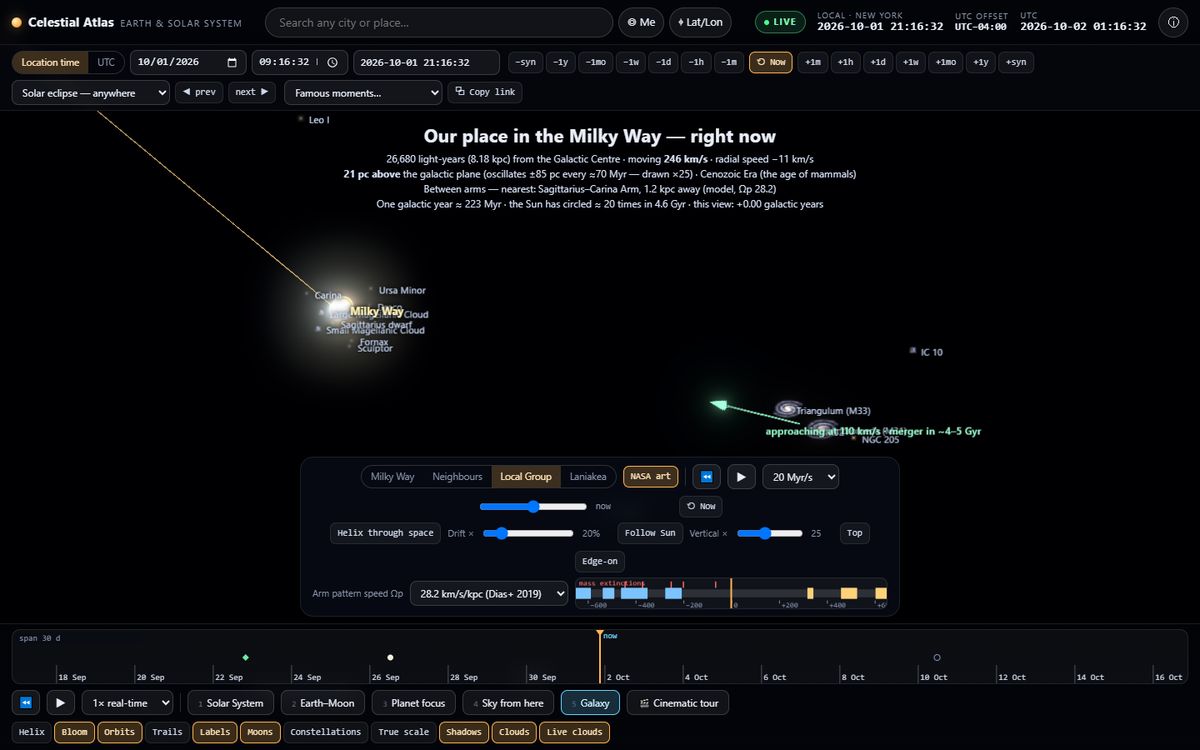
The Milky Way belongs to the Local Group, a collection of about 80 galaxies spread over roughly 10 million light-years. Its two giants are the Milky Way and Andromeda (M31), 2.5 million light-years away and approaching at about 110 km/s. Celestial Atlas draws them, the Triangulum spiral (M33), the Magellanic Clouds and the dwarf galaxies as 3D clouds tilted at their measured orientations, not flat pictures.
The Milky Way's satellites (Neighbours scale)
Dozens of small galaxies orbit the Milky Way. The brightest are the Large Magellanic Cloud (a barred disc about 14,000 light-years across, seen almost face-on, tilted ≈ 35°) and the Small Magellanic Cloud (stretched along our line of sight). The atlas also includes the Sagittarius dwarf galaxy being pulled into a stream of stars as it falls through the Milky Way's disc, and dwarf spheroidals such as Draco, Sculptor, Fornax and Carina, drawn as ellipsoids. Each cloud of points has the right size and tilt; the individual stars are generated, since no one has observed every star in a galaxy 160,000 light-years away.
Andromeda (M31)
Andromeda is the nearest large galaxy and among the farthest objects visible to the naked eye, a faint smudge in autumn skies. It is a spiral roughly as large as the Milky Way (its stellar disc is 150,000–220,000 light-years across depending on the definition) and more massive in stars. Its disc is tilted about 77.5° to our line of sight, so from here it looks nearly edge-on, with a position angle of ≈ 37.7° on the sky; the atlas places its disc at exactly this orientation. Andromeda's spectral lines are blueshifted: it is falling toward the Milky Way at ≈ 110 km/s. See the collision simulation for what happens next.
Triangulum (M33)
M33 is the third large spiral in the group, much smaller than the Milky Way, with a disc 60,000 light-years across tilted ≈ 56°. It is likely bound to Andromeda, orbiting it at a distance of about 750,000 light-years, and in the collision simulation it is drawn in with Andromeda.
The Local Group scale
At the Local Group scale the camera pulls back to ≈ 1.3 Mpc so that the Milky Way, M31 and M33 and their entourage fit in one view. Dwarf spheroidals appear as dim ellipsoids; the glow of each galaxy is a marker that fades into the 3D cloud as you zoom in. Arrows show the approach of M31 and the Local Group's motion.
What is real and what is illustrative
- Real Distances and directions (from catalogues), position angles and inclinations, sizes.
- Illustrative The stars within each galaxy are procedurally generated to match type (spiral, barred, irregular, dwarf spheroidal) and size; real star counts would be billions.
Frequently asked questions
How far away is the Andromeda galaxy?
About 2.5 million light-years (≈ 765–780 kiloparsecs).
Is Andromeda moving toward us?
Yes, at about 110 km/s relative to the Milky Way. Whether and when it collides is explained in the collision simulation page.
What is the Local Group?
The gravitationally bound collection of about 80 galaxies that includes the Milky Way, Andromeda and Triangulum, spanning roughly 10 million light-years.
Can I see Andromeda without a telescope?
Yes, from a dark site it is a faint elongated glow in the constellation Andromeda, in the northern autumn sky.