Celestial Atlas › Learn › Laniakea: the supercluster we live in, and the flow to the Great Attractor
Laniakea: the supercluster we live in, and the flow to the Great Attractor
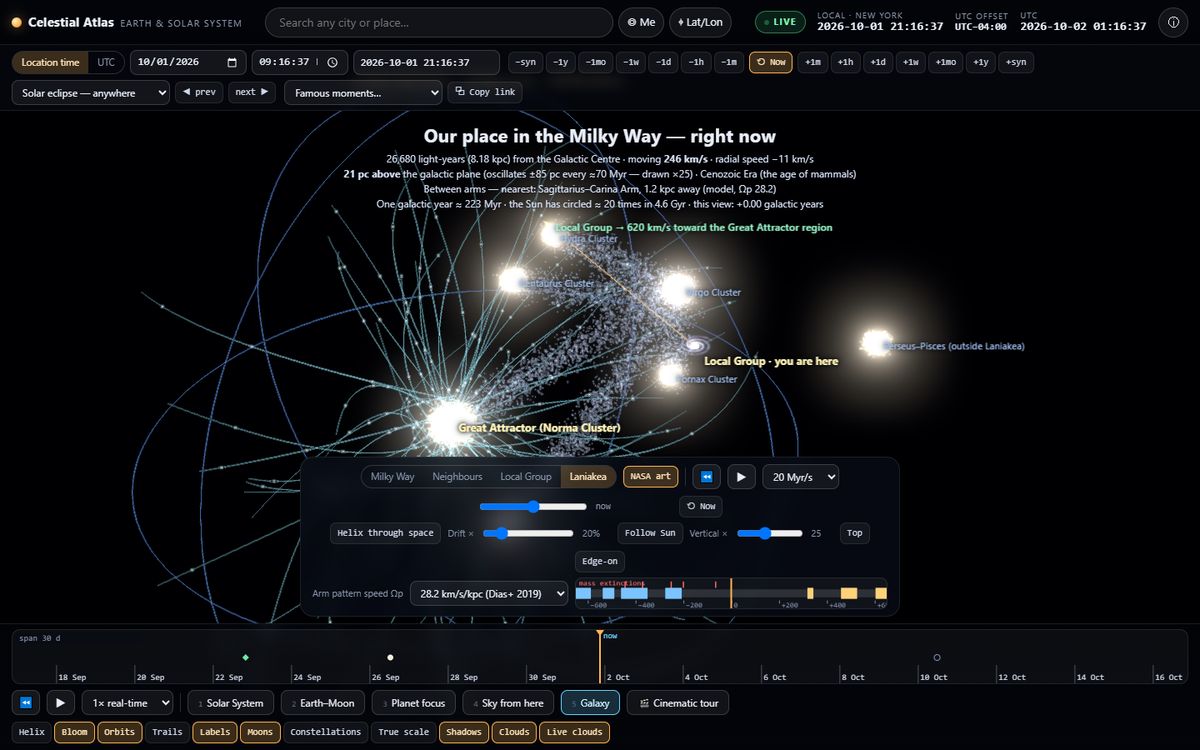
Laniakea (Hawaiian for “immense heaven”) is the supercluster of galaxies that contains the Milky Way: about 100,000 galaxies across 520 million light-years. Galaxies inside it flow toward a common centre, the Great Attractor, and the Local Group is moving that way at about 600 km/s. The atlas shows the structure schematically from catalogue positions of its major clusters.
What a supercluster boundary means
Laniakea was defined in 2014 by mapping galaxy velocities, not just positions. Because the expansion of the Universe carries galaxies apart, each galaxy's extra motion towards denser regions (its “peculiar velocity”) reveals where gravity is pulling it. Laniakea is the region whose galaxies all flow towards the same attractor; its boundary is where the flow turns toward another basin. The older “Virgo Supercluster” is only one lobe of Laniakea.
The Great Attractor and Shapley
The Great Attractor is a large, gravitationally dominant concentration — centred near the Norma cluster, hidden behind the dust of the Milky Way's disc — that anchors Laniakea's flow. Beyond it, in the same general direction but much farther away, lies the Shapley Concentration, one of the most massive structures in the nearby Universe, which lies outside Laniakea in a neighbouring basin; Coma and Perseus–Pisces are other neighbours the atlas labels.
Our motion through the Universe
Relative to the cosmic microwave background, the Sun moves at about 370 km/s, the Milky Way at ≈ 550–560 km/s and the whole Local Group at ≈ 620 km/s, toward the constellations Centaurus/Hydra, the direction of the Great Attractor. This is the “drift” used by the Galaxy view's Helix through space option. Most of this motion is gravity from nearby clusters and the Great Attractor; the Universe's expansion itself carries no preferred direction.
How to read the Laniakea scale
Glows are galaxy clusters placed at their catalogue directions and distances; point clouds around them are schematic member galaxies; blue streamlines show the flow toward the Great Attractor. A label marks the Local Group, and clusters outside Laniakea (such as Perseus–Pisces) are marked as such. The ring around the structure is a scale reference. Zooming in from here, the Galaxies scale shows Hubble's famous galaxies and the Local Group scale shows Andromeda.
What is real and what is illustrative
- Real Cluster directions and distances, the Great Attractor's position, the Local Group's speed and direction.
- Illustrative The flow lines, the filaments and the cloud of member galaxies are schematic: the real 3D map is built from some 18,000 galaxies with measured velocities in the Cosmicflows-3 survey and is not reproduced point by point.
Frequently asked questions
What is Laniakea?
The supercluster of about 100,000 galaxies, 520 million light-years across, that contains the Milky Way, defined by the common flow of its galaxies.
What is the Great Attractor?
A massive concentration of galaxies in the Norma region, about 220 million light-years away, toward which Laniakea's galaxies, including ours, flow.
How fast is the Milky Way moving through the Universe?
About 550–560 km/s relative to the cosmic microwave background (the Sun ≈ 370 km/s, the Local Group ≈ 620 km/s).
What does Laniakea mean?
It is Hawaiian for “immense heaven”: lani (sky, heaven) and ākea (spacious, immeasurable).