Celestial Atlas › Learn › Does the solar system move in a helix? How the Sun carries the planets through the Galaxy
Does the solar system move in a helix? How the Sun carries the planets through the Galaxy
Yes — in a precise, limited sense. The Sun carries the whole solar system around the Milky Way at about 246 km/s, so when you plot where each planet goes through the Galaxy (rather than around the Sun) its path is a stretched corkscrew. But the planets are not trailing behind the Sun in a wake: the helix is a feature of the frame of reference, and it is much more stretched than most animations show.
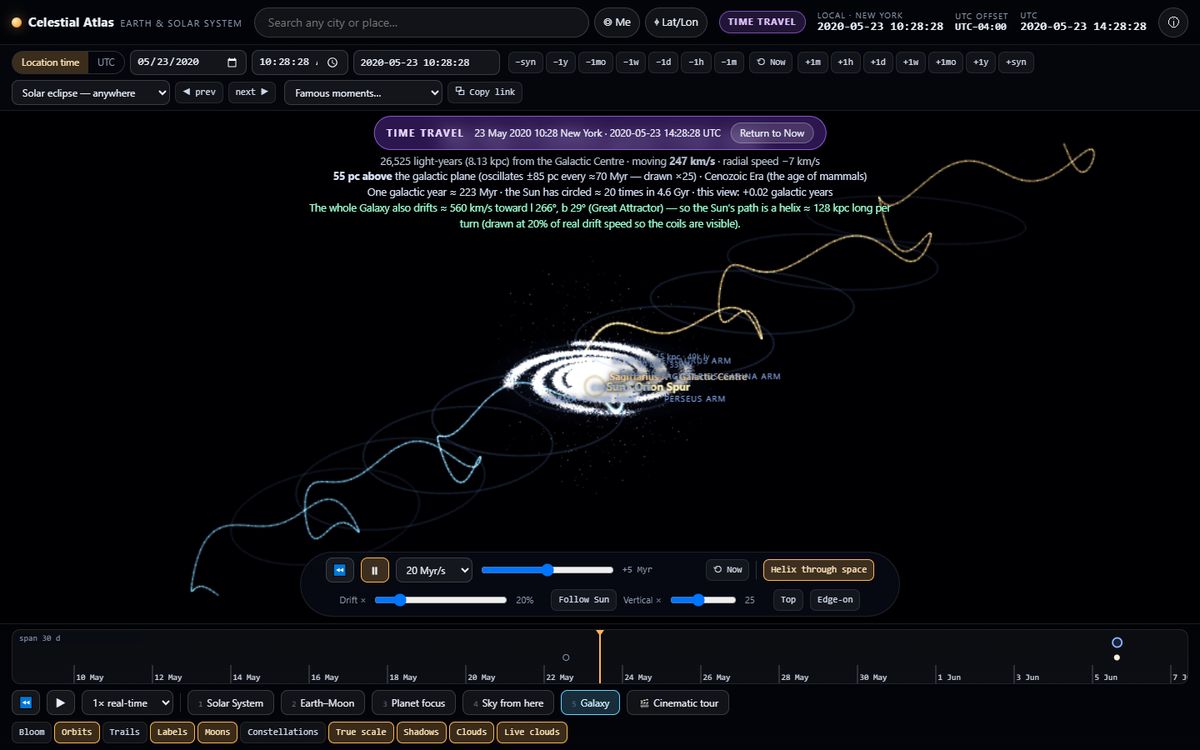
The idea in one picture
Take a pen and hold it still while a friend walks forward holding a small ball on a string and swinging it in circles. From the friend's point of view the ball circles. From where you stand the ball traces a corkscrew. The Sun is the friend, the planets are balls on strings (gravity), and “you” are anyone watching from the Galaxy's frame. Everything in the Sun's neighbourhood moves with it, so planets never fall behind.
Why the helix is so stretched
Earth goes around the Sun at 29.8 km/s, but the Sun moves through the Galaxy at about 246 km/s, roughly eight times faster. In one year Earth completes one turn while the Sun advances about 52 AU. The corkscrew is therefore 52 AU long per turn but only about 1 AU wide: almost a straight line with a small wiggle. The atlas's Helix mode exaggerates the stretch by default so that you can see the coils, and it prints an honest note: “here one turn is N× the orbit's radius; in reality it is 52×”. Switch on True scale and the note changes to explain that the corkscrew is practically a straight line.
| Planet | Orbital speed | Turns during one Sun-year of travel |
|---|---|---|
| Mercury | 47.4 km/s | 4.15 |
| Earth | 29.8 km/s | 1 |
| Jupiter | 13.1 km/s | 0.084 (one turn per 11.9 years) |
| Neptune | 5.4 km/s | 0.006 (one turn per 165 years) |
Where the Sun is heading
The Sun orbits the Galactic Centre clockwise as seen from the north galactic pole, so its direction of travel is roughly toward the constellation Cygnus (galactic longitude ≈ 90°). Relative to the stars in its immediate neighbourhood — the “local standard of rest” — the Sun additionally moves at about 18–20 km/s toward the “solar apex” in Hercules; that is a small correction to the big orbital speed. The atlas uses the Sun's integrated orbit in a galactic potential with a flat rotation curve and the measured peculiar velocity (U, V, W) = (11.1, 12.24, 7.25) km/s, and displays the apex direction as an arrow with a label.
What the popular “vortex” animations get wrong
Viral videos show the planets trailing the Sun in a spiral like a vortex or a comet's tail. That picture implies the planets are being dragged or lag behind, which would require a force that does not exist. In reality the planets are gravitationally bound to the Sun and move with it. The corkscrew exists, but (1) it is vastly more stretched than the videos' tight spirals, (2) the planets' orbital planes are tilted about 60° to the Galactic plane, so the corkscrews are oblique rather than neat coils around a straight axis, and (3) the Sun's own path around the Galaxy is gently curved and wavy, not a straight line. Celestial Atlas draws the true geometry and states the exaggeration it uses.
A helix on a larger scale
The Sun's orbit around the Galactic Centre (one lap every ≈ 223 million years) is itself a ring that bobs up and down through the Galactic plane every ≈ 70 million years. If you also add the Galaxy's own motion through space (about 560 km/s relative to the cosmic microwave background, toward the Great Attractor), the ring is stretched into a giant helix too. In the Galaxy view, switch on Helix through space to see it; drift is drawn at 20% of its real speed by default so the coils are visible, and the setting is explained on screen.
Flat versus helical
Press Compare with flat view in Helix mode to split the screen: on the left the textbook picture (a still Sun and planets circling in a flat plane), on the right the same moment with the Sun's real motion. Drag the divider to look at more of either side. The same comparison exists in the Galaxy view.
What is real and what is illustrative
- Real The Sun's velocity and direction, the planets' real orbits and the resulting paths in the Galaxy's frame.
- Illustrative The degree of stretch in the default view (adjustable; True scale shows the real ratio) and the colours/fading of the trails.
Frequently asked questions
Is the solar system really moving through space in a spiral?
Yes, in the Galaxy's frame: the planets follow stretched corkscrew paths because the Sun carries them around the Milky Way at about 246 km/s. They are not trailing behind it, though; they move with it.
How fast is the solar system moving?
About 246 km/s (roughly 885,000 km/h) around the centre of the Milky Way, and about 560 km/s relative to the cosmic microwave background once the Galaxy's own motion is included.
Which direction is the Sun moving?
Around the Galaxy toward galactic longitude ≈ 87°, latitude ≈ 2°, in the direction of the constellation Cygnus.
Why don't the planets get left behind?
Because they, and the whole neighbourhood of stars, share the Sun's motion; gravity only binds them to the Sun, so there is no wake or drag.