Celestial Atlas › Learn › The life cycle of the Sun: birth, red giant, planetary nebula and white dwarf
The life cycle of the Sun: birth, red giant, planetary nebula and white dwarf
The Sun is about 4.57 billion years old, roughly halfway through its hydrogen-burning life. It will brighten slowly, making Earth uninhabitable in roughly a billion years; leave the main sequence in about 5.4 billion years; swell into a red giant 256 times its present radius about 7.6 billion years from now; and finish as an Earth-sized white dwarf of about 0.54 solar masses. The atlas animates the whole life, with the planets' fates and Earth's ocean loss.
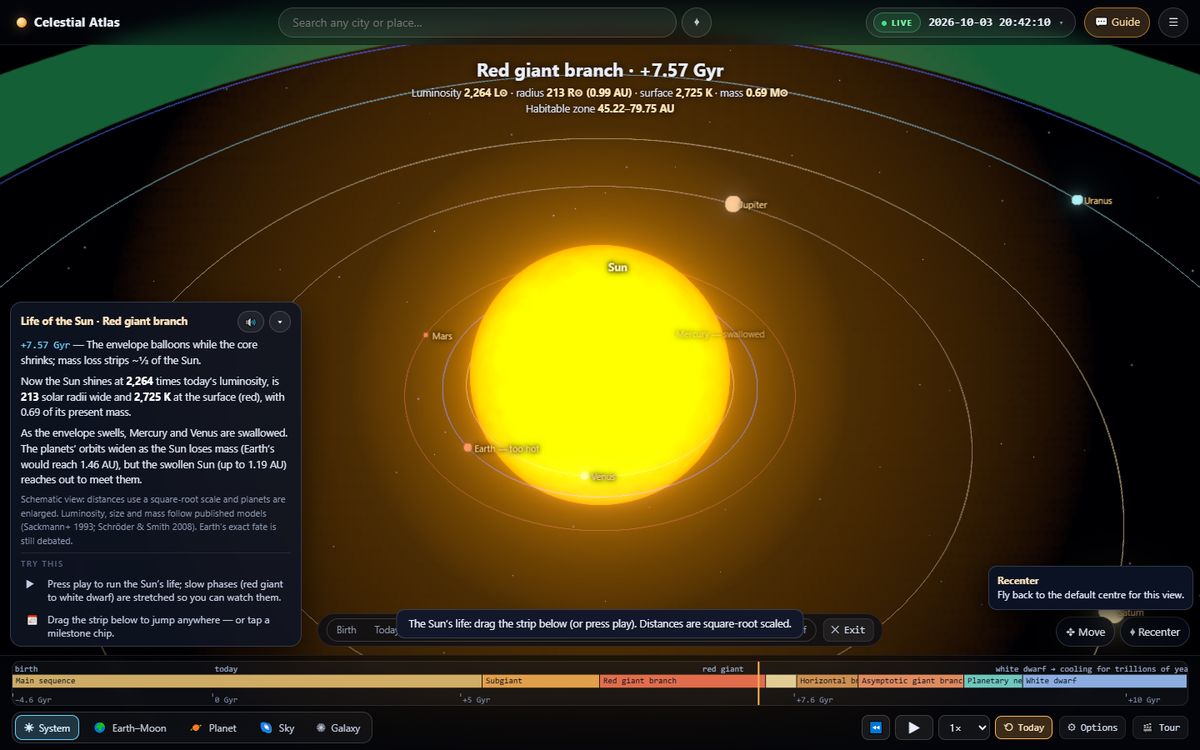
The timeline
| Stage | Time from now | Luminosity (L☉) | Radius (R☉) | Surface T | Mass (M☉) |
|---|---|---|---|---|---|
| Birth (zero-age main sequence) | −4.57 Gyr | 0.70 | 0.89 | ≈ 5,600 K | 1.00 |
| Today (main sequence) | 0 | 1.00 | 1.00 | 5,772 K | 1.00 |
| Earth leaves the habitable zone | +1.1 Gyr | 1.10 | 1.04 | ≈ 5,800 K | 1.00 |
| End of main sequence | +5.4 Gyr | 2.1 | 1.6 | ≈ 5,500 K | 1.00 |
| Red giant branch begins | +6.9 Gyr | 3 | 2.5 | ≈ 4,800 K | 0.99 |
| Tip of the red giant branch (helium flash) | +7.59 Gyr | 2,730 | 256 | ≈ 2,600 K | 0.67 |
| Horizontal branch (helium burning) | +7.60–7.70 Gyr | ≈ 44 | ≈ 10 | ≈ 4,800 K | 0.62–0.66 |
| Asymptotic giant branch (peak) | +7.78 Gyr | ≈ 5,200 | ≈ 180 | ≈ 3,650 K | 0.56 |
| Planetary nebula | +7.78–7.80 Gyr | ≈ 3,000 → 100 | 0.4 → 0.03 | → > 100,000 K | 0.54 |
| White dwarf, 1 Gyr after | +9 Gyr | 0.01 | 0.0135 | ≈ 14,000 K | 0.54 |
The values follow published models of the Sun's evolution (Sackmann, Boothroyd & Kraemer 1993; Schröder & Smith 2008). The surface temperature in the atlas is computed from luminosity and radius, T = 5,772 K × (L/R²)¼, so the colours stay consistent: yellow-white now, orange then deep red as a giant, blue-white for the hot core of the planetary nebula.
What happens to Earth
Brightening is slow — about 1% per 100 million years — but cumulative. When the Sun's output is about 10% higher than today's (in roughly 1.1 billion years), the stratosphere can no longer hold water: a moist greenhouse sets in, oceans begin to evaporate and are lost to space over the following hundreds of millions of years, leaving a hot, dry planet. The atlas uses the simple flux limits of Kopparapu et al. (2013), 1.107 and 0.356 times Earth's present solar flux, for the inner and outer edge of the habitable zone (0.95–1.68 AU today) and shows Earth's temperature and ocean percentage: about 15 °C and 100% today, ≈ 170 °C and 60% oceans at +1.7 Gyr, 360 °C and none at +3.2 Gyr. It is a deliberately simple model: real climate physics would change the details and timing.
Which planets are swallowed
As the Sun loses mass its gravity weakens and the planets' orbits widen in proportion to 1/M. At the red-giant tip the Sun's radius is 1.19 AU (256 R☉), while Mercury's orbit has grown to 0.58 AU, Venus's to 1.08 AU, Earth's to 1.49 AU and Mars's to 2.27 AU. Mercury and Venus are engulfed. Earth is a close call: Schröder & Smith (2008) found that tidal drag would probably pull it in, so the atlas treats it as swallowed once the Sun's radius reaches about 70% of Earth's orbit; its fate is still debated. Mars and the outer planets survive, with orbits widened by roughly 1.85× (the Sun's final 0.54 solar masses): Jupiter ends near 9.6 AU, Neptune near 56 AU.
The atlas also prints each planet's temperature (an equilibrium estimate: T = 278.5 K × (1−A)¼ L¼/√a, plus a greenhouse offset for Venus). Today Mercury ≈ 160 °C, Venus ≈ 465 °C, Earth 15 °C, Mars ≈ −63 °C.
The planetary nebula and the white dwarf
After the final helium-shell flashes the Sun ejects its outer layers (nearly half of its mass is lost in total, from 1.0 to about 0.54 solar masses). The exposed core, now over 100,000 K, ionises the ejected gas, which glows as a planetary nebula for about 20,000 years — a name that comes from the round, planet-like look through early telescopes, not from planets. What remains is a white dwarf of carbon and oxygen with about 54% of the Sun's present mass squeezed into a sphere the size of Earth. It no longer burns fuel and simply cools for trillions of years towards a black dwarf. The atlas shows the expanding shell and then the faint hot dwarf with the surviving planets on their widened orbits.
How to use the Sun's life view
In the Solar System view press ☀ Sun's life. Drag the strip at the bottom or press play: slow stages (the red-giant branch, helium flash, planetary nebula) are stretched so that you can watch them. Chips jump to Birth, Today, the end of Earth's habitable window, the subgiant, red giant, planetary nebula and white dwarf. Distances use a square-root scale so that both a 0.005 AU star and a 30 AU Neptune fit on screen; planets are enlarged. The green band is the habitable zone.
What is real and what is illustrative
- Real Luminosity, radius and mass versus time (published models); the engulfment geometry; orbit widening ∝ 1/M.
- Illustrative Distances are square-root scaled; planet sizes are enlarged; temperatures are energy-balance estimates; Earth's ocean loss is a simple threshold model; the timing of the helium flash and later stages is compressed on the strip so that you can see them.
Frequently asked questions
When will the Sun die?
It leaves the main sequence in about 5.4 billion years, becomes a red giant around 7 billion years from now and ends as a white dwarf about 7.8 billion years from now.
Will the Earth be swallowed by the Sun?
Mercury and Venus will; Earth probably will too through tidal drag (Schröder & Smith 2008), though the outcome is debated. Mars and the outer planets survive.
When will Earth become uninhabitable?
As the Sun brightens about 1% every 100 million years, Earth leaves the habitable zone in roughly 1 billion years and its oceans are lost over the next billion or so.
What is a planetary nebula?
A shell of gas ejected by a dying Sun-like star and lit up by its hot core for about 20,000 years; it has nothing to do with planets.
Will the Sun explode as a supernova?
No. The Sun is too small; it will end as a white dwarf.