Celestial Atlas › Learn › The Milky Way–Andromeda collision: simulation, timeline and the final merged galaxy
The Milky Way–Andromeda collision: simulation, timeline and the final merged galaxy
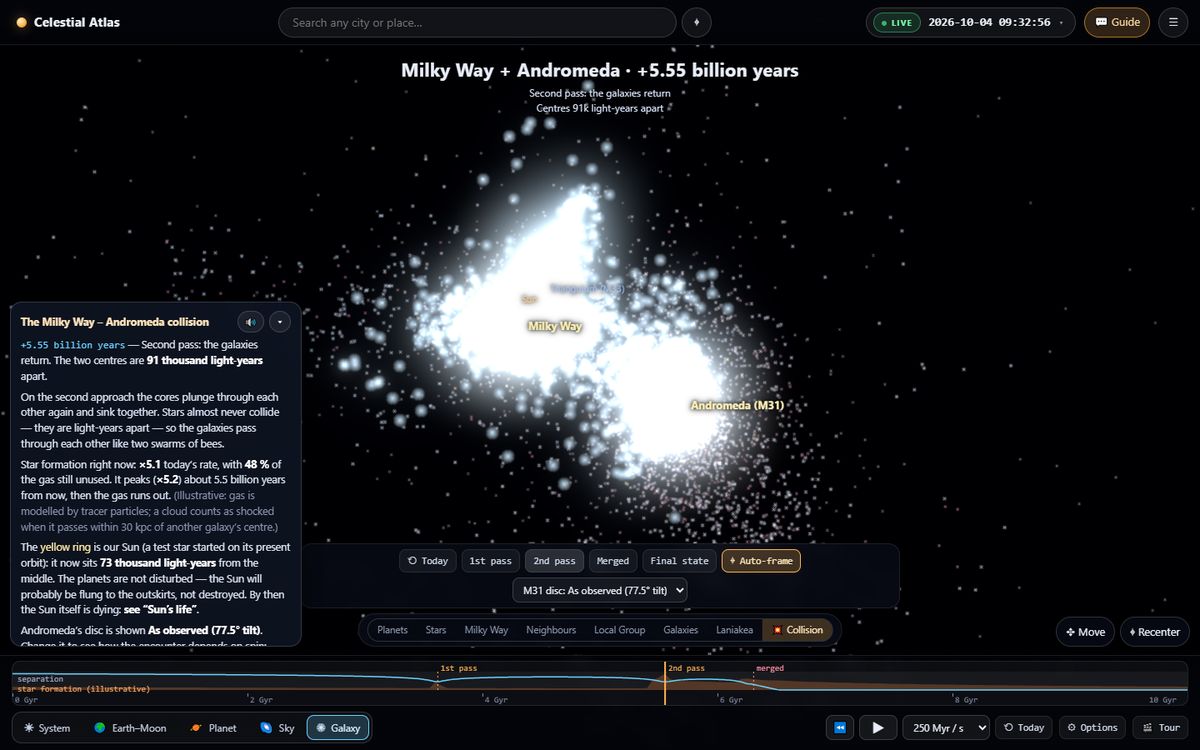
Andromeda is approaching the Milky Way at about 110 km/s. The atlas lets you play out what a collision would look like: a first close pass about 3.6 billion years from now, a second at about 5.6 billion, and a single merged elliptical galaxy — sometimes nicknamed “Milkomeda” — by about 6.4 billion years. It is an illustrative simulation tuned to published timelines, and the page explains exactly what is and is not modelled.
What happens
Gravity pulls the two galaxies together. As they fall, tidal forces begin to stretch their outer discs. At the first close pass, the centres come within ≈ 30 kpc (about 100,000 light-years); stars are flung out in long tidal tails and a bridge. Dynamical friction — the drag from each galaxy's dark-matter halo — slows the pair, so they turn around and return for a second pass. A few hundred million years later the cores spiral together and the galaxies coalesce into one smooth, reddish elliptical galaxy in which the original discs are gone. Stars almost never collide: stars are so far apart (the nearest star to the Sun is 4.25 light-years away, about 30 million star-diameters) that the galaxies pass through each other like two swarms of bees.
What happens to the Sun and Earth?
The yellow ring in the simulation is a test star started on the Sun's present orbit. In this model it ends tens of thousands of light-years from the remnant's centre, in the outskirts, rather than being flung out of the galaxy or swallowed by the centre; published simulations similarly find the Sun is likely to end up much farther from the centre than today. The solar system itself survives: a close stellar encounter is very unlikely. The Sun will also be nearing the end of its main-sequence life by then — see the life cycle of the Sun.
Triangulum and the gas
Triangulum (M33), a smaller spiral bound to Andromeda, is simulated as a third galaxy on its own orbit; it spends the first several billion years circling Andromeda and is then drawn into the merger. Each galaxy's gas is represented by tracer particles. When a gas cloud passes within 30 kpc of another galaxy's centre, it is counted as shocked — the cause of merger starbursts in real galaxies — and glows blue-white. The strip at the bottom plots an illustrative star-formation history: rate ×(1 + 12 × shocked fraction) × the gas still available, with a gas-depletion time of 6 Gyr. The bursts at the passes and the shut-down after the merger match the qualitative behaviour seen in full hydrodynamic simulations, but the numbers are not predictions.
Changing Andromeda's spin
The spin direction of Andromeda's disc relative to the orbit is not observable, and it matters: a prograde disc (spinning with the orbit) throws out the longest tidal tails, a retrograde one hardly any. Use the selector in the bar to choose observed, prograde, retrograde or edge-on discs; the stars are re-simulated (the orbit does not depend on the discs) and cached.
How the simulation works
The two big galaxies are softened, truncated isothermal dark-matter haloes with flat rotation curves (225 and 250 km/s). Their centres follow a two-body orbit starting from Andromeda's observed distance and velocity (≈ 109 km/s radial, ≈ 28 km/s tangential), with Chandrasekhar dynamical friction tuned so that the timeline matches the literature. Stars and gas clouds are test particles: they feel the haloes but not each other, and a reversible leapfrog integrator advances them in 2-million-year steps (≈ 0.5 ms per step in your browser). Checkpoints every 200 Myr make scrubbing instant; reversing time works because the integrator is time-reversible.
Limits and honesty
- Real The initial positions and velocities of Andromeda, M33 and the Milky Way; the orbit's timeline is tuned to published values.
- Illustrative Stars do not attract each other and gas does not dissipate or cool: real gas would lose energy and sink to the centre, igniting a nuclear starburst and perhaps feeding the black holes. No supermassive black holes, no galactic bars or spiral arms regenerating, no dark-matter substructure.
- Illustrative The merger is not certain. Newer measurements from the Hubble and Gaia space telescopes, which include the pull of the Large Magellanic Cloud, give a roughly 50% chance of a merger within 10 billion years (Salomon et al. 2021) and a first pass nearer 4.5 billion years (van der Marel et al. 2019). The atlas shows the “if it happens” case.
Frequently asked questions
When will the Milky Way and Andromeda collide?
Estimates put the first close pass at about 4 billion years from now (3.9–4.5 Gyr) and the final merger at roughly 6–7 billion years; the atlas's simulation shows 3.6 and 6.4 Gyr. A newer analysis suggests the collision is only about 50% likely within 10 billion years.
What will the merged galaxy be called?
It is nicknamed Milkomeda (also “Milkdromeda”). It is expected to be a giant elliptical galaxy.
Will stars collide?
Almost never: the distances between stars are enormous compared with their sizes, so the galaxies pass through each other.
Will the Earth be destroyed in the collision?
No. The solar system is very unlikely to be disturbed, although the Sun may be moved to a different part of the new galaxy. Earth will have been made uninhabitable by the Sun's brightening long before.
Sources and further reading
- van der Marel et al. 2012 — The M31 velocity vector. III: future Milky Way–M31–M33 orbital evolution
- van der Marel et al. 2019 — First Gaia dynamics of the Andromeda system
- Cox & Loeb 2008 — The collision between the Milky Way and Andromeda
- Sohn et al. 2012 — HST proper motion of M31
- Salomon et al. 2021 — The proper motion of Andromeda from Gaia EDR3: confirming a nearly radial orbit
- Andromeda–Milky Way collision (Wikipedia)